- Roof
- Loft insulation
- Wojciech Dobry
- October 2026
- about 8 min
- 3:04, Polish captions
How much mineral wool for an attic? Rolls for a gable roof
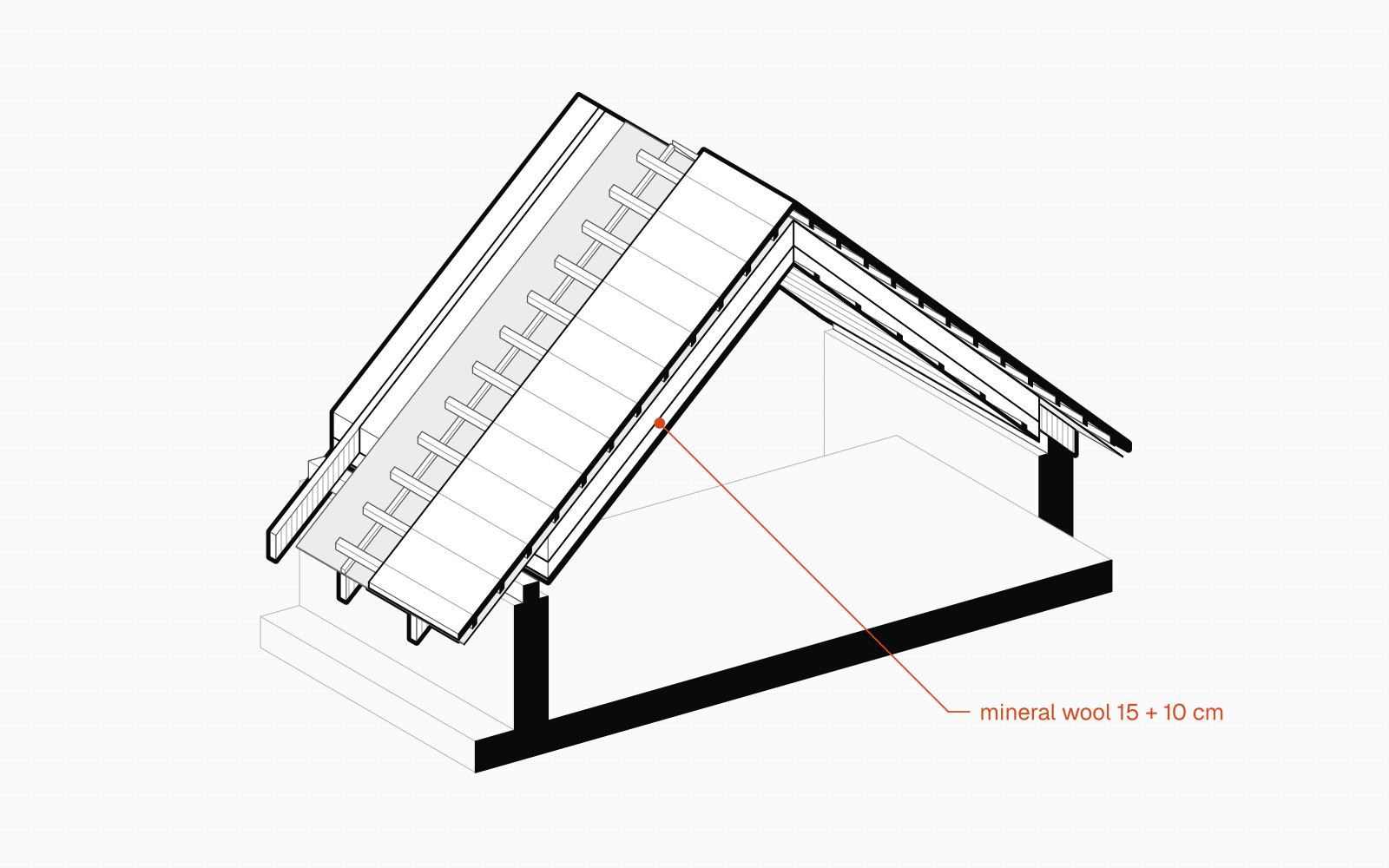
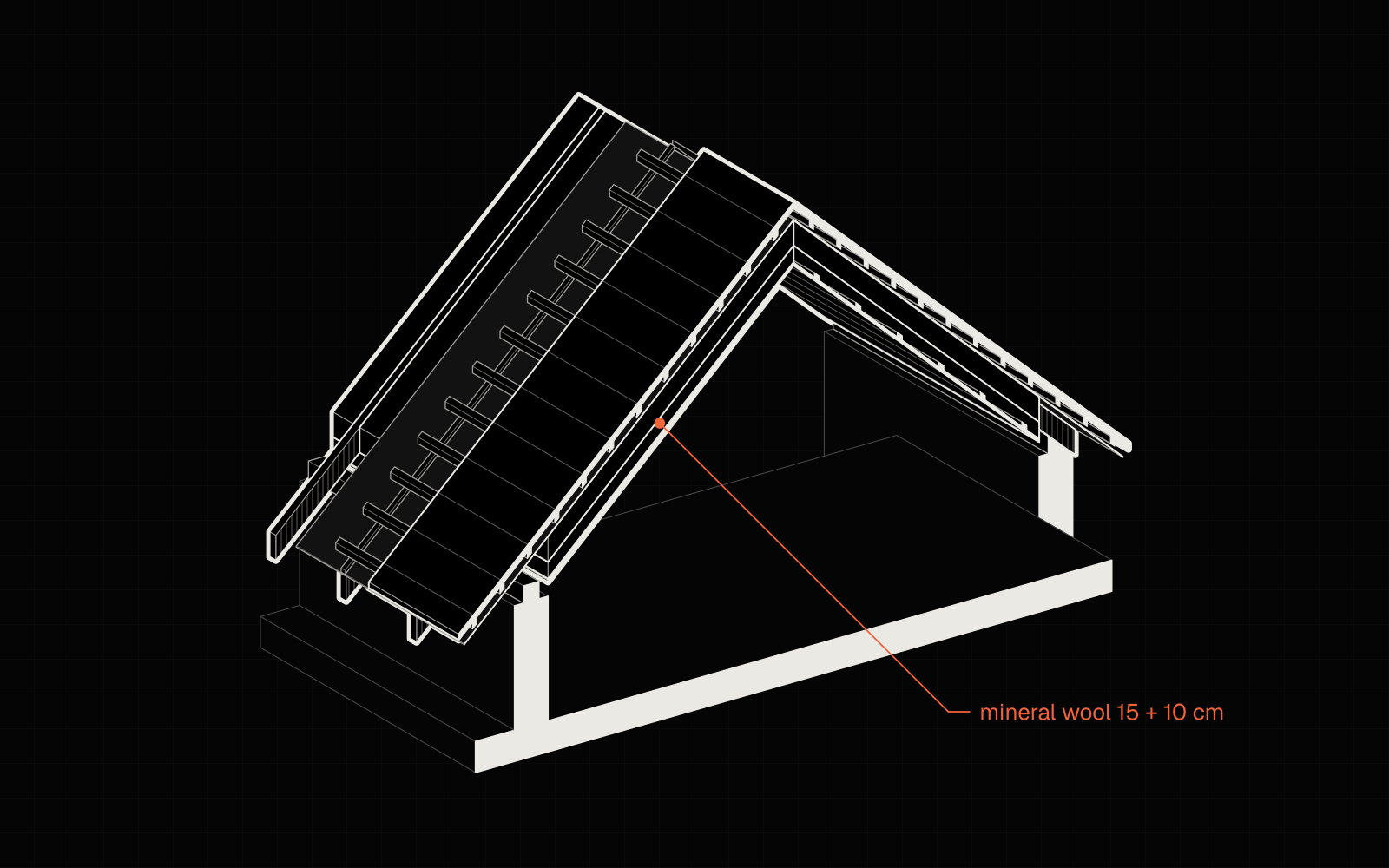
For the attic of a 14.15 × 8.44 m house (about 141 m² of slopes and ceiling under the collar ties), buy about 33 rolls of 15 cm mineral wool to lay between the rafters and about 25 rolls of 10 cm wool under the rafters, 25 cm in all. You work out the insulated area from the inside, not the roof area: here it is only about 85% of the roof, because the eaves and the triangle above the collar ties lie outside the insulation.
How to calculate it
insulated area = attic length × (length of the slopes from the knee wall to the collar ties + width of the ceiling under the collar ties)
rolls = insulated area × (1 + waste) ÷ m² per roll, separately for each layer
Insulated area. Measure from the inside, where the wool will lie: along the slope from the top edge of the knee wall to the collar ties, then along the flat ceiling under the collar ties, and down the slope again on the other side. The attic length is the distance between the gable walls, measured inside. The eaves, the wall thickness and the triangle above the collar ties (an unheated loft) are not insulated from the inside, so you don't count them.
- insulated area
- mineral wool 15 + 10 cm
- roof covering
Knee walls and gables are usually insulated from the outside together with the facade. If you insulate them from the inside, add them separately.
Roof windows should be deducted if they are large or there are many of them. With a few small windows, the difference fits within the waste.
Two layers. Wool is usually laid in two layers: the first between the rafters (usually as thick as the rafters are deep, e.g. 15 cm), the second under the rafters, across the first, between the profiles of the frame for the plasterboard. You work out each layer from the same area but a different roll: the thicker the wool, the fewer m² in a roll.
Choose the thickness so that the roof meets the Polish building regulations (the technical conditions, WT) in their 2021 version: a heat transfer coefficient U of at most 0.15 W/(m²·K). U says how much heat passes through 1 m² of the roof for each degree of difference between inside and outside; the lower it is, the better the insulation. The 2002 regulation on technical conditions (WT) ceased to apply on 21 September 2026, and a new one has not yet been published (as of October 2026). Until about March 2028 a house may be designed to the previous requirements if the investor makes a declaration to that effect (Article 102a of the Polish Construction Law). With wool of λ = 0.035 W/(m·K) that usually means at least 25 cm, and with λ = 0.039 as much as 30 cm. More in the article mineral wool thickness for an attic under WT.
- 20 cm, λ 0.0350.171more than 0.15: not enough
- 25 cm, λ 0.035 (example)0.137meets it
- 30 cm, λ 0.0350.115meets it
- 25 cm, λ 0.0390.153more than 0.15: not enough
- 30 cm, λ 0.0390.128meets it
The vapour barrier goes on the inside, under the wool, over the whole insulated area, with overlaps of about 10–15 cm taped together and turned up onto the walls. Count the insulated area plus about 10%. Details in the article vapour barrier: how many m² and what overlaps.
Waste
| Material | Waste | Why |
|---|---|---|
| Wool between the rafters | about 5% | Cuts at roof windows, chimneys and gables; the rafters take up part of the area, which partly offsets the cuts |
| Wool under the rafters | about 5% | Cuts at the edges and windows |
| Vapour barrier | 10% | Overlaps and upstands onto the walls |
Baukit works with the same values; they are site practice. You buy wool in whole rolls or packs, so the rounding alone provides part of the waste.
Example: a 13.37 m attic with a flat ceiling under the collar ties
Assumptions as in the free “PS.Arch 150” design from the catalogue of GUNB, the Polish building control authority: an attic 13.37 m long (inside), slopes of 3.40 m on each side and a ceiling 3.75 m wide under the collar ties. Glass wool with λ = 0.035 W/(m·K): 15 cm between the rafters (roll of 4.5 m²) and 10 cm under the rafters (roll of 6 m²), 5% waste. Vapour barrier in rolls of 75 m². The example in Baukit uses the same data.
- Insulated area. 13.37 × (3.40 + 3.75 + 3.40) = 13.37 × 10.55 = 141.05 m².
- With 5% waste. 141.05 × 1.05 = 148.1 m².
- 15 cm layer. 148.1 ÷ 4.5 = 32.9, which is 33 rolls.
- 10 cm layer. 148.1 ÷ 6.0 = 24.7, which is 25 rolls.
- Vapour barrier. 141.05 × 1.10 = 155.2 m², which is 3 rolls of 75 m².
- Checking the thickness. Resistance of the wool: 0.25 ÷ 0.035 = 7.14 m²·K/W. With the surface resistances (0.10 inside and 0.04 outside), U = 1 ÷ (0.10 + 7.14 + 0.04) = 0.137 W/(m²·K), which is less than 0.15. This calculation leaves out the rafters, through which more heat escapes, so the real U will be a little higher.
- Insulated area
- 141.05 m²
- Vapour barrier (+10%)
- 155.2 m², 3 rolls
- U at 25 cm
- 0.137 ≤ 0.15
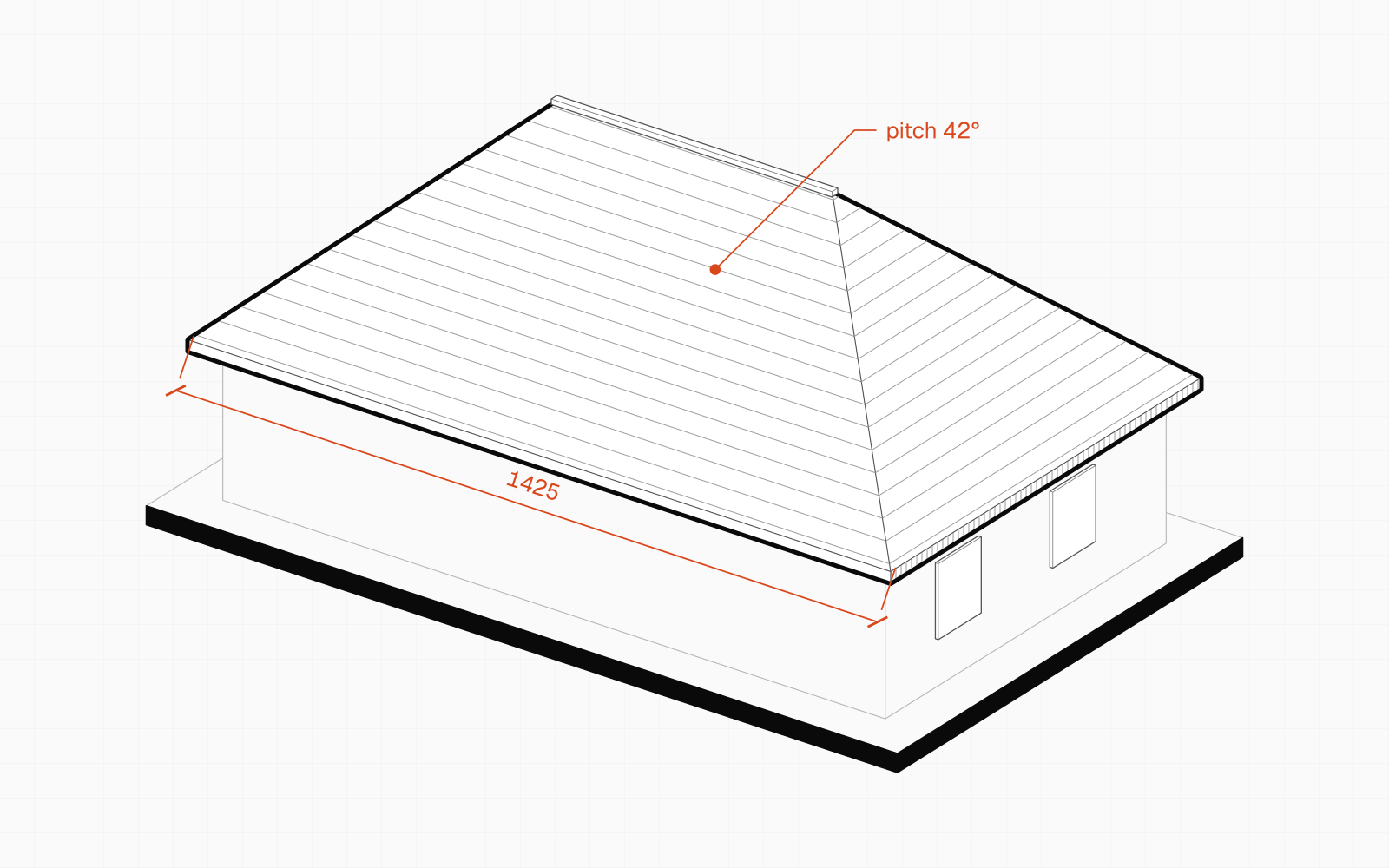
The roof of this house is 165.87 m², and the insulation from the inside 141.05 m², which is about 85% of the roof. If you ordered the wool for the roof area, you would buy about 25 m² too much in each layer. The “PS.Arch 150” design specifies 15 + 12 cm of wool, which is 27 cm.
- Roof165.8739 rolls of 15 cm and 30 rolls of 10 cm
- Insulation from inside141.05about 85% of the roof: 33 and 25 rolls
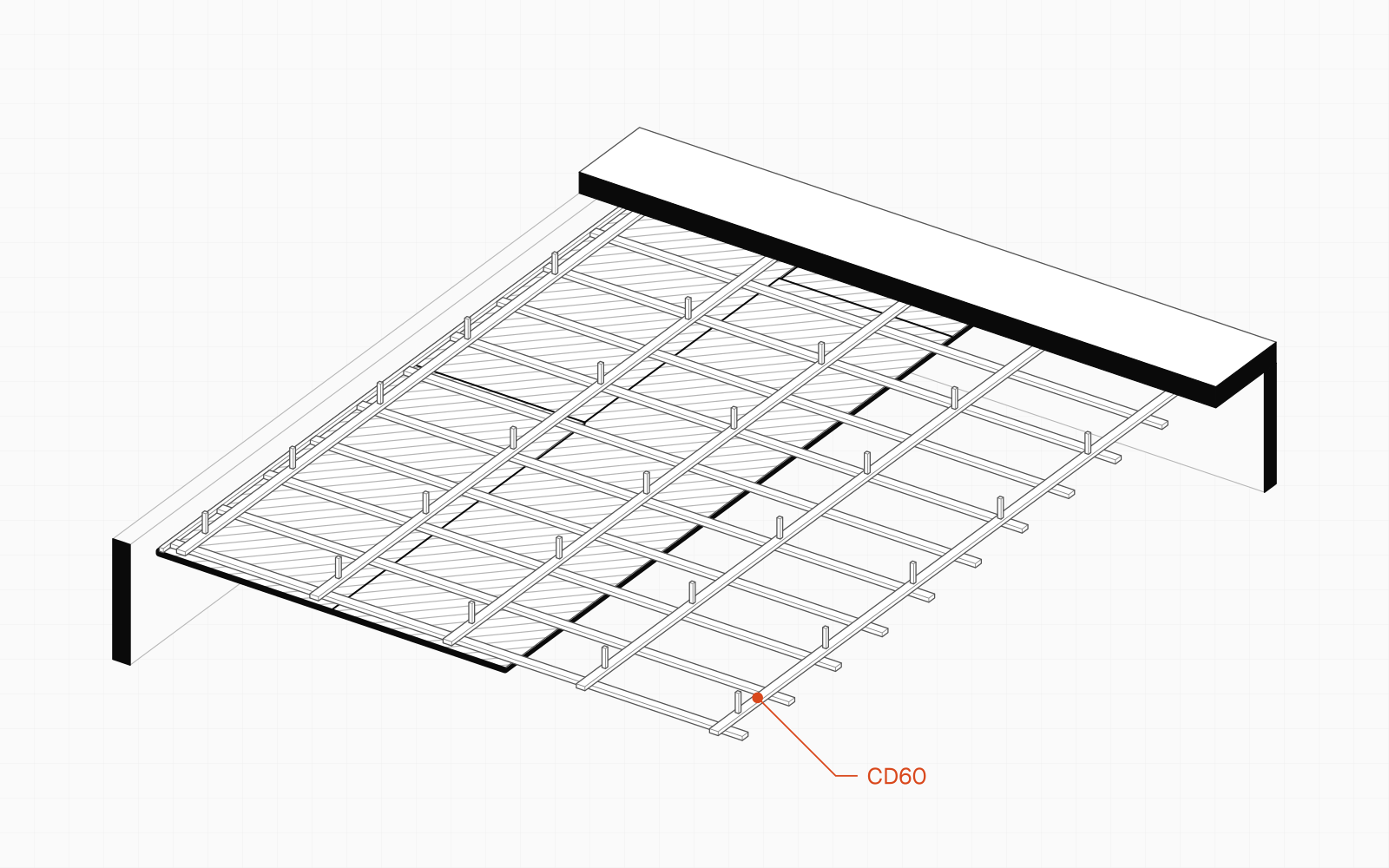
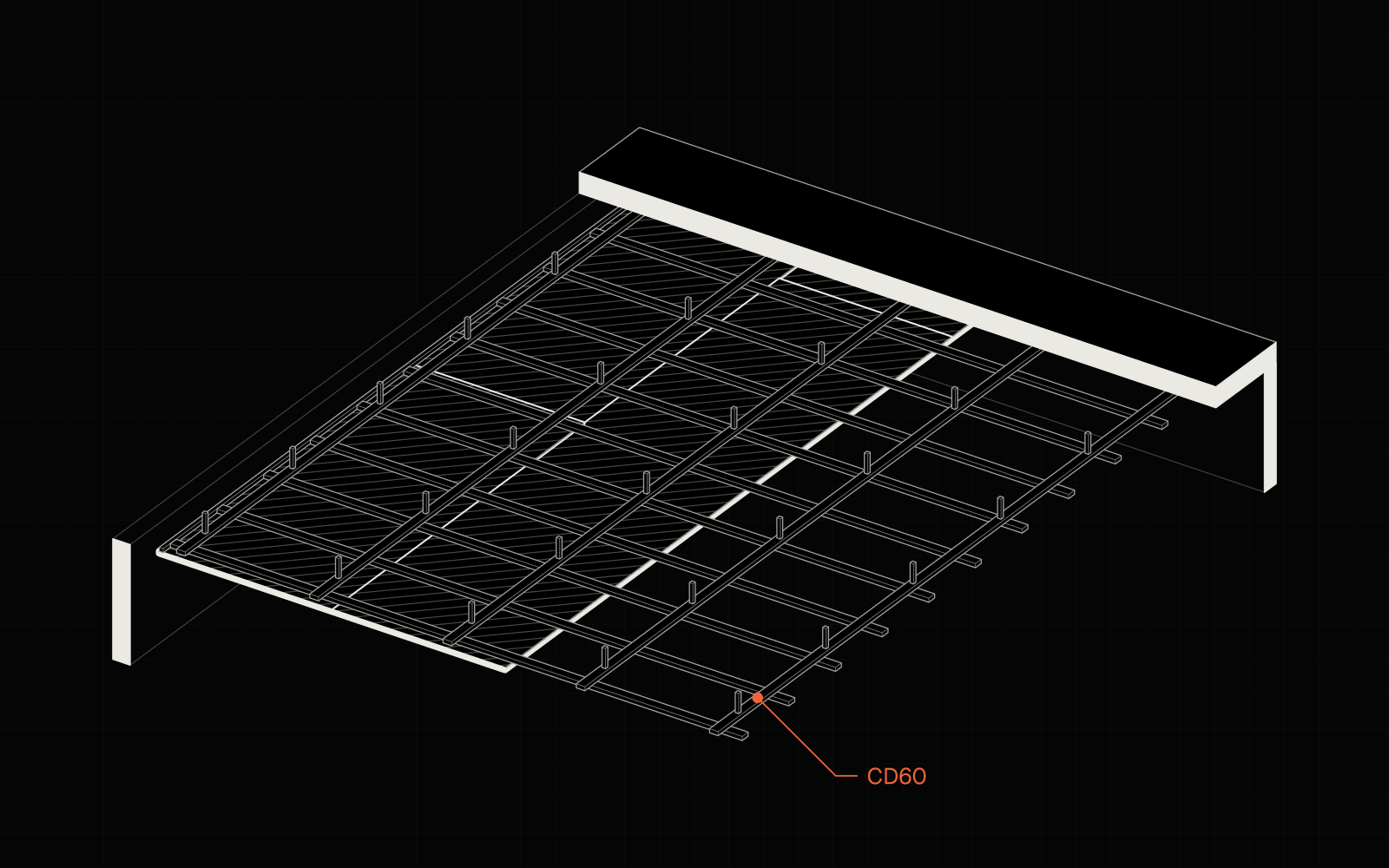
Under the wool you also need a frame and plasterboard over the same area: work them out like a suspended ceiling.
- Mineral wool 15 cm33rolls of 4.5 m², between the rafters
- Mineral wool 10 cm25rolls of 6 m², under the rafters
- Vapour barrier3rolls of 75 m² (155.16 m²)
- Frame and plasterboard141.05 m²work out as a suspended ceiling
What it costs
| Material | Typical price | ||
|---|---|---|---|
| Glass mineral wool roll λ 0.035–0.039, 150 mmPack: roll (usually 3–6 m²) | 24.04 PLN/m²approx. 108 PLN per pack23.18–28.66 · 3 shops | 23.18–28.66 | 3 shops |
| Glass mineral wool roll λ 0.035–0.039, 120 mmPack: roll (usually 5–8 m²) | 21.10 PLN/m²approx. 116 PLN per pack18.43–23.78 · 2 shops | 18.43–23.78 | 2 shops |
| Glass mineral wool roll λ 0.035–0.039, 100 mmPack: roll (usually 5–8 m²) | 15.46 PLN/m²approx. 93 PLN per pack14.97–18.74 · 3 shops | 14.97–18.74 | 3 shops |
| Roof vapour barrier membrane approx. 0.2 mmPack: 75 m² roll | 1.45 PLN/m²approx. 109 PLN per pack1.29–1.50 · 3 shops | 1.29–1.50 | 3 shops |
| CD 60/27 ceiling profile 3 mPack: 3 m length | 2.76 PLN/mapprox. 8 PLN per pack1.98–3.00 · 3 shops | 1.98–3.00 | 3 shops |
| UD 28/27 perimeter channel 3 mPack: 3 m length | 2.30 PLN/mapprox. 7 PLN per pack1.93–2.56 · 3 shops | 1.93–2.56 | 3 shops |
| Direct hanger ES 60/125 for CD 60 profilePack: pack of 100 | 1.19 PLN/pcapprox. 119 PLN per pack0.68–1.75 · 3 shops | 0.68–1.75 | 3 shops |
| Plasterboard GKB (type A) 12.5 mm 1200×2600Pack: sheet 1.2×2.6 m | 10.54 PLN/m²approx. 33 PLN per pack9.59–10.73 · 3 shops | 9.59–10.73 | 3 shops |
The prices in the table are the median of offers from several shops, including VAT, dated. Compare wool per square metre at the same thickness and the same λ: a cheaper wool with a worse λ needs a thicker layer.
Work it out in Baukit
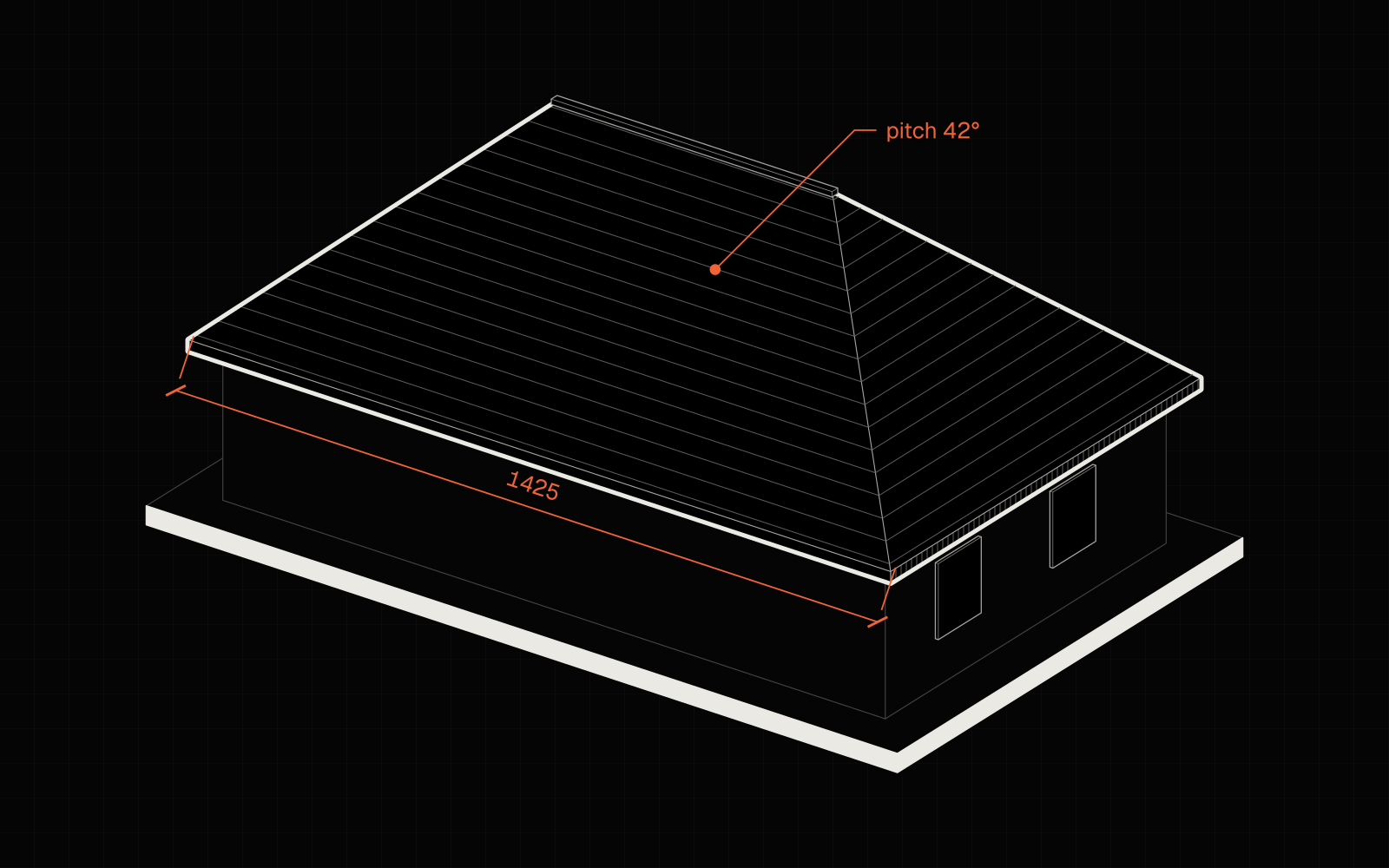
Open in Baukit- Click “Open in Baukit”. A house with an attic storey and a 42° roof opens, with the notebook open.
- Select the roof. The notebook shows the insulated area from the inside, the rolls in two layers, the vapour barrier and the tape.
- Change the wool thickness from 20 to 30 cm in the panel on the right and see the new number of rolls.
- Hover over the wool row to see the insulated part of the roof in the section.
- Open the notebook with the “Notebook” button in the bottom left corner or with the 4 key.
The same model also works out the frame and plasterboard under the slopes and the usable floor area of the attic.
Frequently asked questions
Is 20 cm of wool enough for an attic?
Usually not. With λ = 0.035, a 20 cm layer gives U ≈ 0.17 W/(m²·K), and WT 2021 requires at most 0.15 for a roof. You need at least about 25 cm of such wool, and with λ = 0.039 about 30 cm.
What thickness of wool for an attic under the building regulations?
A roof over a heated attic must have a U of at most 0.15 W/(m²·K). With λ 0.035 wool that is about 25–30 cm, with λ 0.039 about 30 cm, in two layers. Work out the exact thickness from the λ given on the wool's label.
How many rolls of wool for a 100 m² attic?
With 15 cm wool in rolls of 4.5 m² and 5% waste, it is 105 m², which is 24 rolls. For a second 10 cm layer in rolls of 6 m² you need 18 rolls. The m² per roll differ between manufacturers, so always check the label.
Is a vapour barrier needed?
Yes: when you insulate an attic with wool from the inside, a vapour barrier protects the wool from the water vapour coming from the rooms. It must be airtight: tape the overlaps and seal the edges at the walls and roof windows. The membrane on the roof is a different layer and does not replace the vapour barrier.
Wool in rolls or in slabs?
Rolls are cheaper and quicker to lay over large areas. Slabs are easier to cut to fit between unevenly spaced rafters and hold better upright. You work them out the same way: area times waste, divided by the m² per pack.
Related
- Mineral wool thickness for an attic under WT 2021: is 20 cm enough?
- Vapour barrier: how many m² and what overlaps
5 sources
- Rozporządzenie w sprawie warunków technicznych, jakim powinny odpowiadać budynki i ich usytuowanie (WT 2002; the Polish regulation on the technical conditions for buildings), consolidated text Dz.U. 2022 item 1225 as amended, Annex 2 (roof U ≤ 0.15 W/(m²·K)) (not checked); deemed repealed from 21 September 2026 (ISAP, in Polish); designs may follow the previous rules for 18 months from 20 September 2026 on the basis of the investor's declaration (Article 102a of the Construction Law, added by the act Dz.U. 2026 item 1161, in Polish), read on 13 October 2026.
- PN-EN ISO 6946, surface resistances Rsi = 0.10 and Rse = 0.04 m²·K/W for upward heat flow (not checked).
- Layout of the wool layers, the vapour barrier and its overlaps: mineral wool manufacturers' guidelines (not checked).
- “PS.Arch 150”, przedmiar robót budowlanych (bill of quantities), author: PS.Arch Piotr Świątkiewicz, 20 November 2023; Główny Urząd Nadzoru Budowlanego, katalog bezpłatnych projektów domów (in Polish), published 15 December 2023 (in the downloads as “Wariant I”): 15 and 12 cm wool, vapour barrier and plasterboard lining over 141.05 m².
- Example: Baukit calculation, 11 October 2026.