- Finishing
- Laminate flooring
- Wojciech Dobry
- October 2026
- about 6 min
- 3:27, Polish captions
Laminate flooring waste: 5, 10 or 15%? By pattern
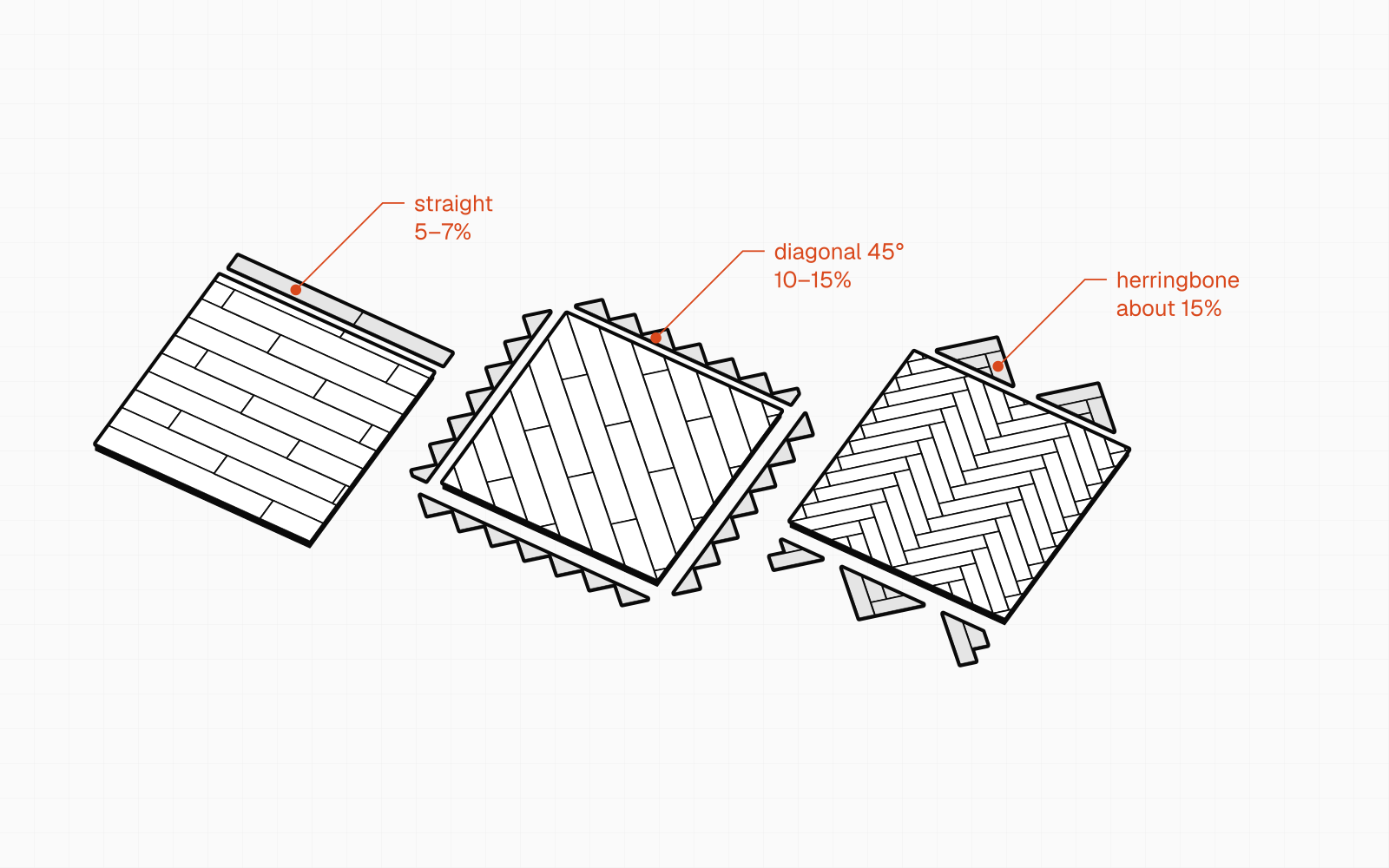
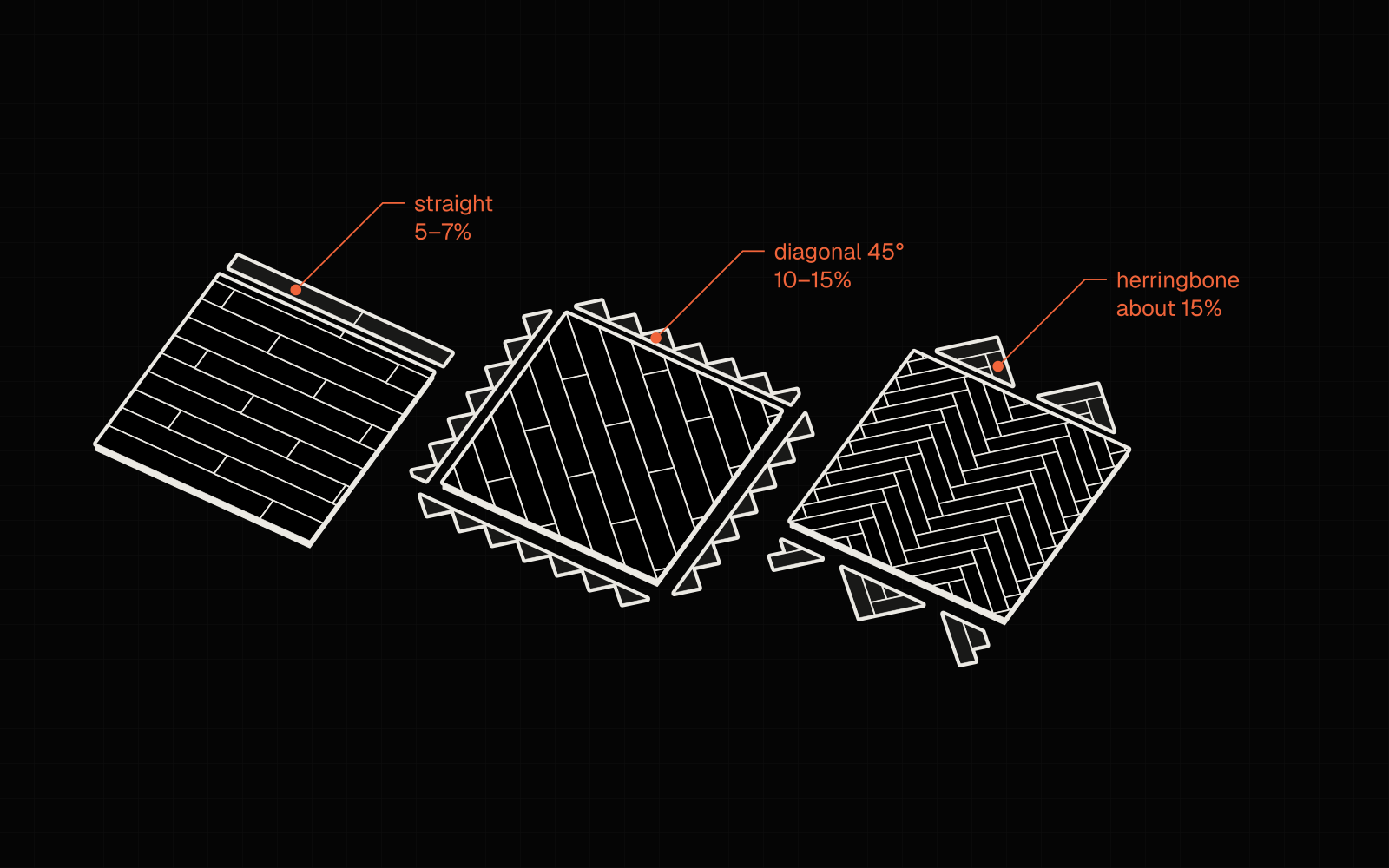
For a straight pattern in a rectangular room, 5–7% waste is enough; in a room smaller than 10 m² allow about 10%, for a diagonal pattern about 12%, and for herringbone about 15%. Alcoves, pillars and an L shape add offcuts that Baukit does not count: add the waste for them yourself. Before you add a pack, though, check how much waste the rounding up to whole packs already gives you, because it is often more than you assume. The full calculation of flooring, underlay and skirting boards is in the article how much laminate flooring for a room.
How to calculate
m² needed = floor area × (1 + waste)
number of packs = m² needed ÷ m² per pack, rounded up
actual waste = (number of packs × m² per pack) ÷ floor area − 1
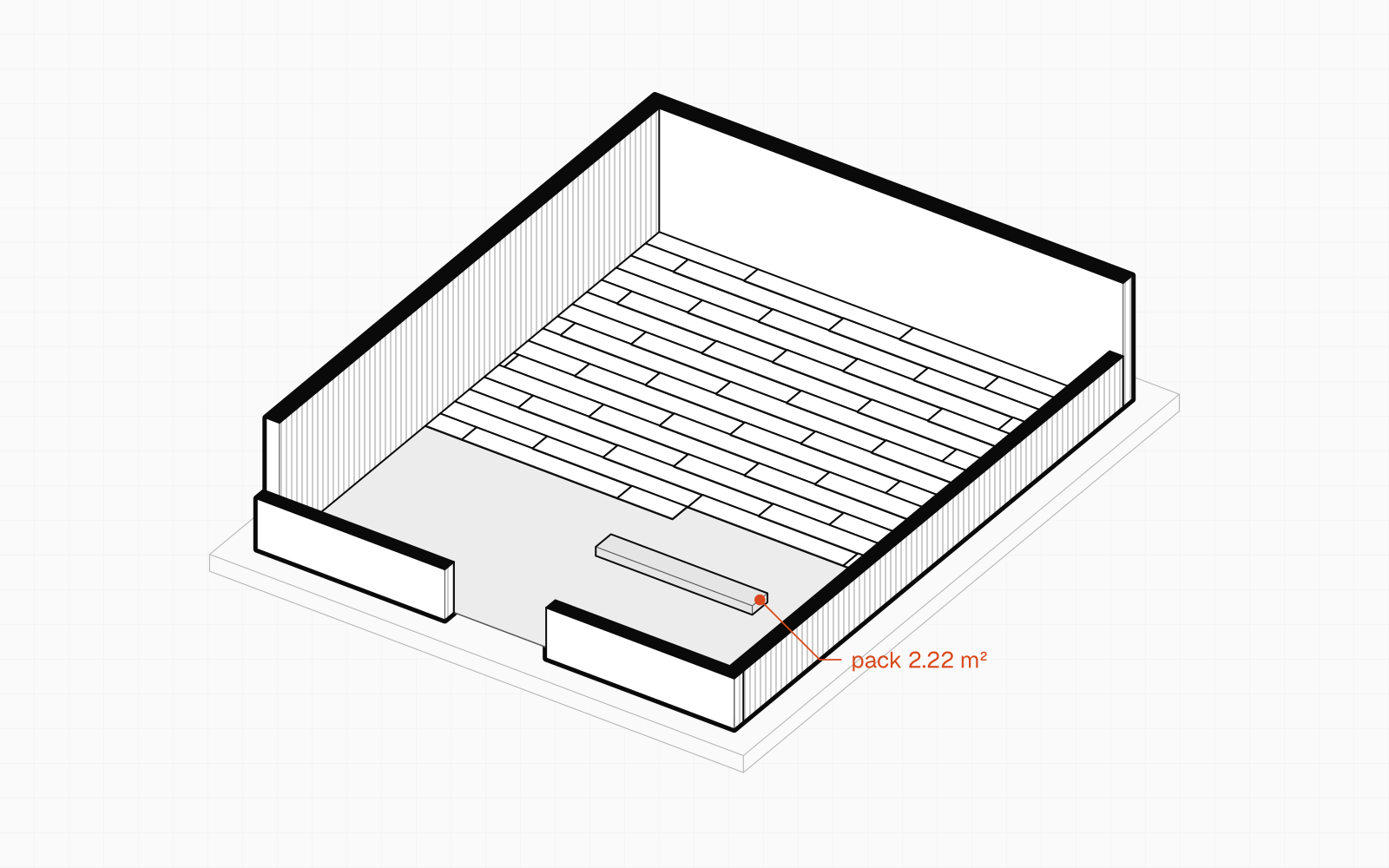
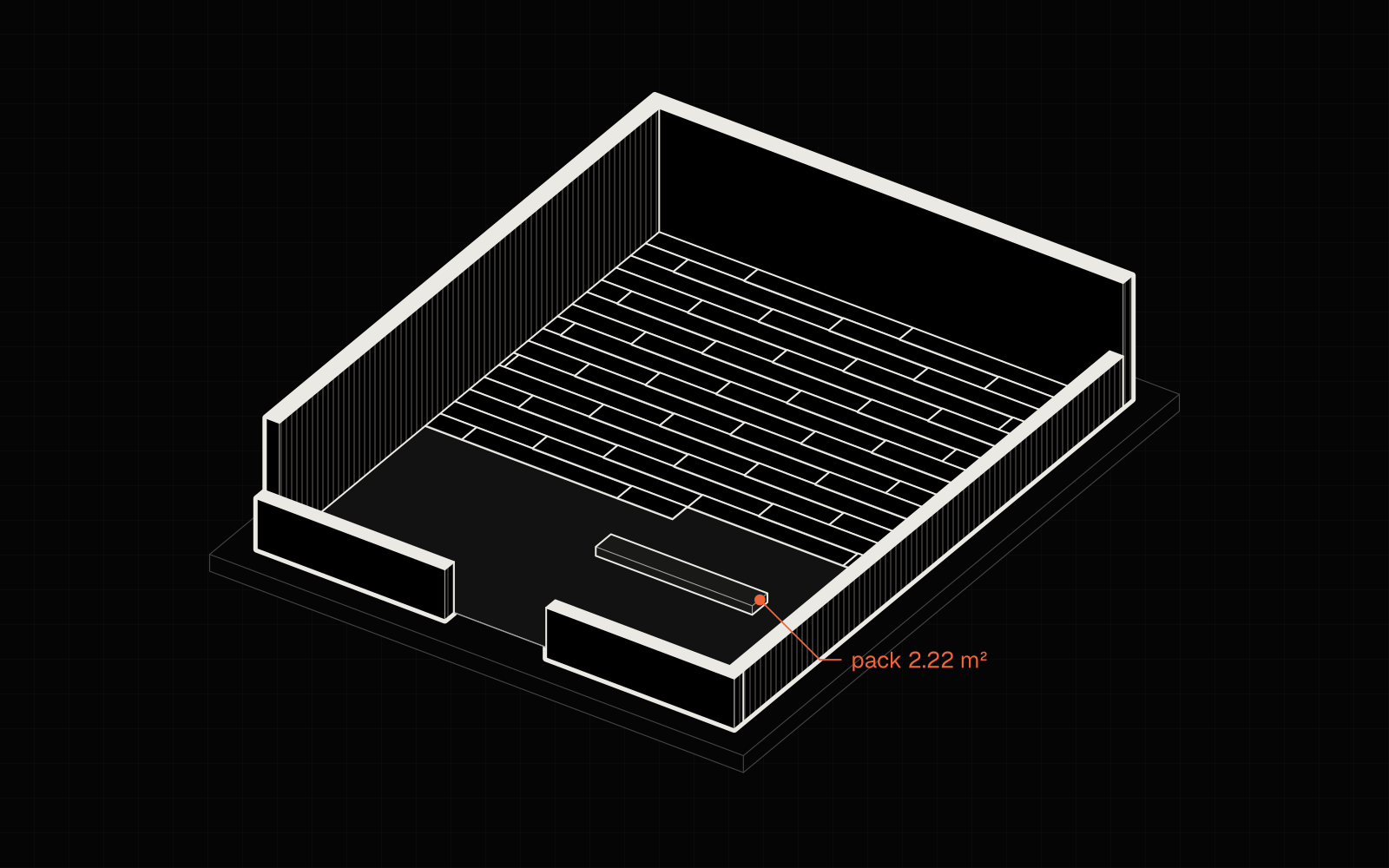
Where does the waste come from in the first place? With a straight pattern you lay the boards in rows. You cut the last board in a row to length, and the offcut starts the next row if it is at least about 30 cm long. You usually stagger the end joints in neighbouring rows by at least 30–40 cm, so not every piece fits. You rip the last row along the wall lengthwise, and the strip you cut off usually goes to waste. On top of that come the cuts around the door frame, pipes and corners.
- piece from the end of the previous row
- waste
The smaller the room, the larger the share of it that the same cuts along the walls take up. That is why a small room or a hallway needs proportionally more waste than a living room.
With a diagonal pattern (at 45°) you finish every row with an angled cut at two walls, and the triangles you cut off are rarely any use. In herringbone short boards meet at an angle, and you cut them along all four walls. Herringbone boards are usually a separate product, sold in different packs from boards for a straight pattern.
- full board
- board cut at the wall
Waste
- Straight, room of 10 m² or more5–7%
- Straight, room smaller than 10 m²approx. 10%
- Offset patternapprox. 10%
- Diagonal (45°)approx. 12%
- Herringboneapprox. 15%
| Situation | Waste in Baukit | Why |
|---|---|---|
| Straight, room of 10 m² or more | 7% | Offcuts start the following rows |
| Straight, room smaller than 10 m², hallway | 10% | The cuts along the walls are a larger share of the floor |
| Offset pattern | 10% | Staggered joints leave more short pieces |
| Diagonal (45°) | 12% | Angled cuts at two walls in every row |
| Herringbone | 15% | Cuts along every wall |
This is the waste Baukit adds, by pattern and room size. The figures are typical recommendations from flooring manufacturers and DIY shops, and the installation instructions of the flooring you buy take precedence. Baukit does not detect obstacles: with alcoves, a pillar, a chimney breast, sloping walls, several doors or an L-shaped room, add the waste yourself by choosing a pattern with more waste or buying an extra pack. If it is your first time laying a floor yourself, also add about 3–5% for cutting mistakes.
Example: how much waste rounding gives you
Assumptions: flooring in packs of 2.22 m². For each room you work out the m² needed at four waste values, round up to whole packs and check the actual waste.
| Room | Floor | 5% | 7% | 10% | 15% |
|---|---|---|---|---|---|
| 3 × 5 m | 15.0 m² | 8 packs | 8 packs | 8 packs | 8 packs |
| 4 × 5 m | 20.0 m² | 10 packs | 10 packs | 10 packs | 11 packs |
| 5 × 6 m | 30.0 m² | 15 packs | 15 packs | 15 packs | 16 packs |
| Hallway 1.2 × 6 m | 7.2 m² | 4 packs | 4 packs | 4 packs | 4 packs |
- You buy
- 22.20 m²
- Assumed waste
- 7%
- Actual waste
- 11%
Step by step for the 3 × 5 m room with a straight pattern:
- m² needed. 15.00 × 1.07 = 16.05 m².
- Packs. 16.05 ÷ 2.22 = 7.23, so 8 packs.
- You buy. 8 × 2.22 = 17.76 m².
- Actual waste. 17.76 ÷ 15.00 − 1 = 18%.
So in this room eight packs are enough even for herringbone (17.25 m² needed). The 4 × 5 m room is different: 10 packs give 11% waste, which is enough for a straight or an offset pattern (10% waste), but a diagonal pattern (12%) and herringbone (15%) need an eleventh pack. In the 1.2 × 6 m hallway, four packs give as much as 23% waste.
- 3 × 5 m, 15.0 m²18%8 packs = 17.76 m²
- 4 × 5 m, 20.0 m²11%10 packs = 22.20 m²
- 5 × 6 m, 30.0 m²11%15 packs = 33.30 m²
- Hallway 1.2 × 6 m, 7.2 m²23%4 packs = 8.88 m²
The lesson: do not add a pack “just in case” until you have worked out the actual waste. Sometimes the rounding alone already gives you more than you need.
Calculate it in Baukit
Open in Baukit- Straight, 7%21.40 m²
- Offset, 10%22.00 m²
- Diagonal, 12%22.40 m²
- Herringbone, 15%23.00 m²
- Open the example: a 4 × 5 m room with one door and the notebook open.
- The room is already selected. The notebook shows the m² of flooring needed with 7% waste: 21.40 m².
- In the panel on the right, in the “Appearance” section, switch the “Pattern”: straight (7% waste), offset (10%), diagonal (12%) and herringbone (15%). With herringbone the flooring goes up to 23.00 m².
- Press Esc so that nothing is selected. In the whole-building view, the flooring line shows the number of packs to buy. Compare the packs with the m² needed: the difference is the waste the rounding alone gives you.
Frequently asked questions
What percentage of waste for a straight laminate floor?
Usually 5–7%, if the room is rectangular and at least 10 m²; Baukit counts 7%. In a room smaller than 10 m² Baukit counts 10%. With alcoves and pillars, add the waste yourself, because Baukit does not detect them. Also check whether rounding up to whole packs already gives you enough waste.
How much waste for herringbone flooring?
Baukit counts 15%. Small rooms and many obstacles may need more, and Baukit does not add that. Herringbone boards usually come in different packs from boards for a straight pattern, so divide by the m² printed on their label.
Does a diagonal pattern need more flooring?
Yes. Allow about 12% waste instead of 7% for a straight pattern, because you finish every row with an angled cut at two walls. You lose the most in narrow rooms, where the rows are short.
Can I return an unused pack of flooring?
Many shops take it back if the pack is unopened and undamaged, but the return rules depend on the shop. Still, it is worth keeping one pack for future repairs, because the same design may disappear from the range.
Should I count flooring for several rooms together or separately?
Count each room separately, with its own waste, and only then add up the m² needed and round up to packs once, for the whole order. You usually cannot carry offcuts from one room to another, but you can use what is left of the last pack. This way you avoid buying a separate, part-used pack for every room.
Related
3 sources
- Waste for offcuts and staggering of joints: typical recommendations from laminate flooring manufacturers and DIY shops' guides, read in October 2026 (values to be confirmed against installation instructions; not checked).
- Pack size 2.22 m²: the Baukit materials catalogue (8 mm AC4 laminate flooring), October 2026.
- Table of packs: Baukit calculation, 11 October 2026.