- Finishing
- Tiles, adhesive and grout
- Wojciech Dobry
- October 2026
- about 8 min
- 2:58, Polish captions
How many tiles to buy? Formula, 10% or 15% waste, example
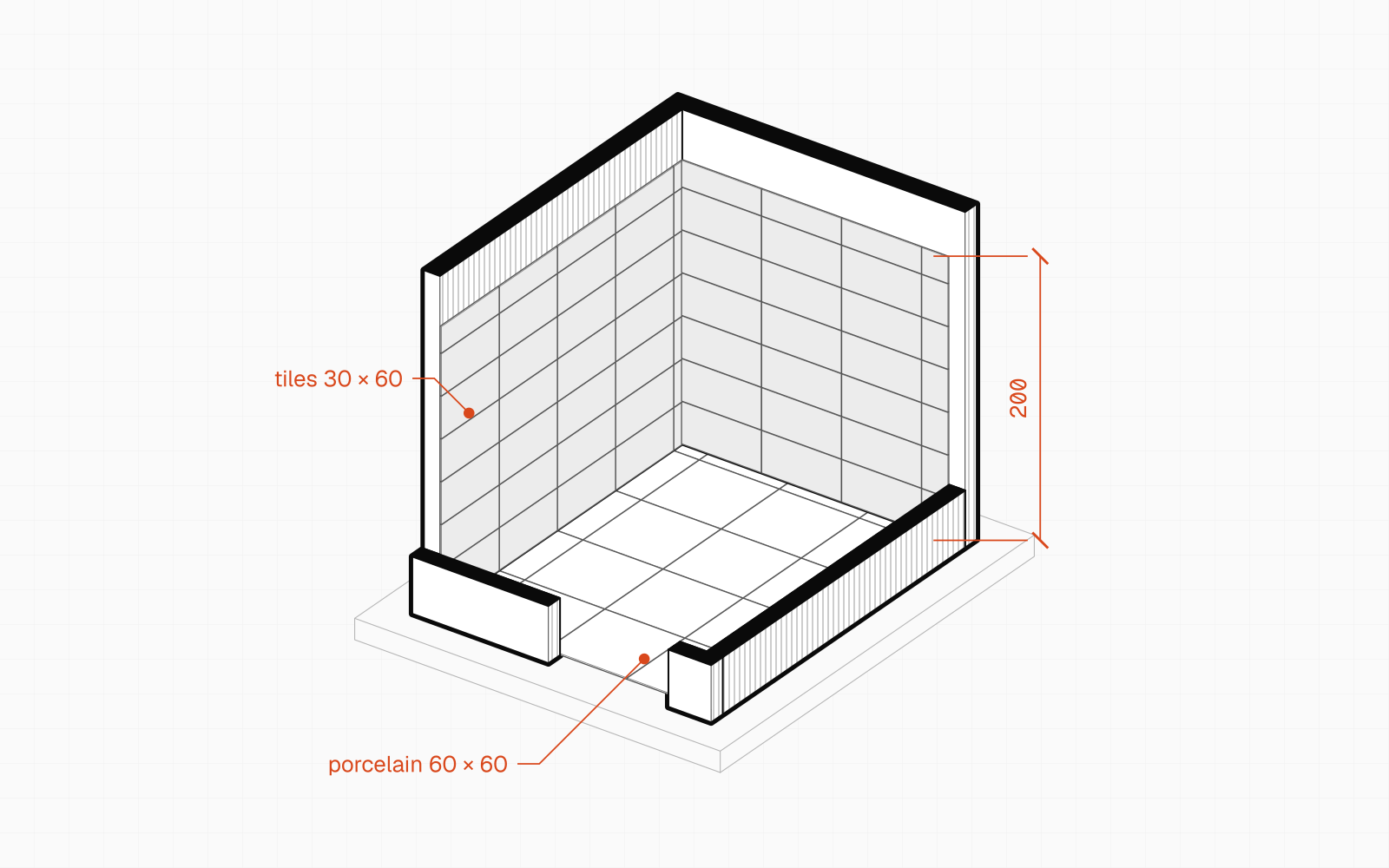
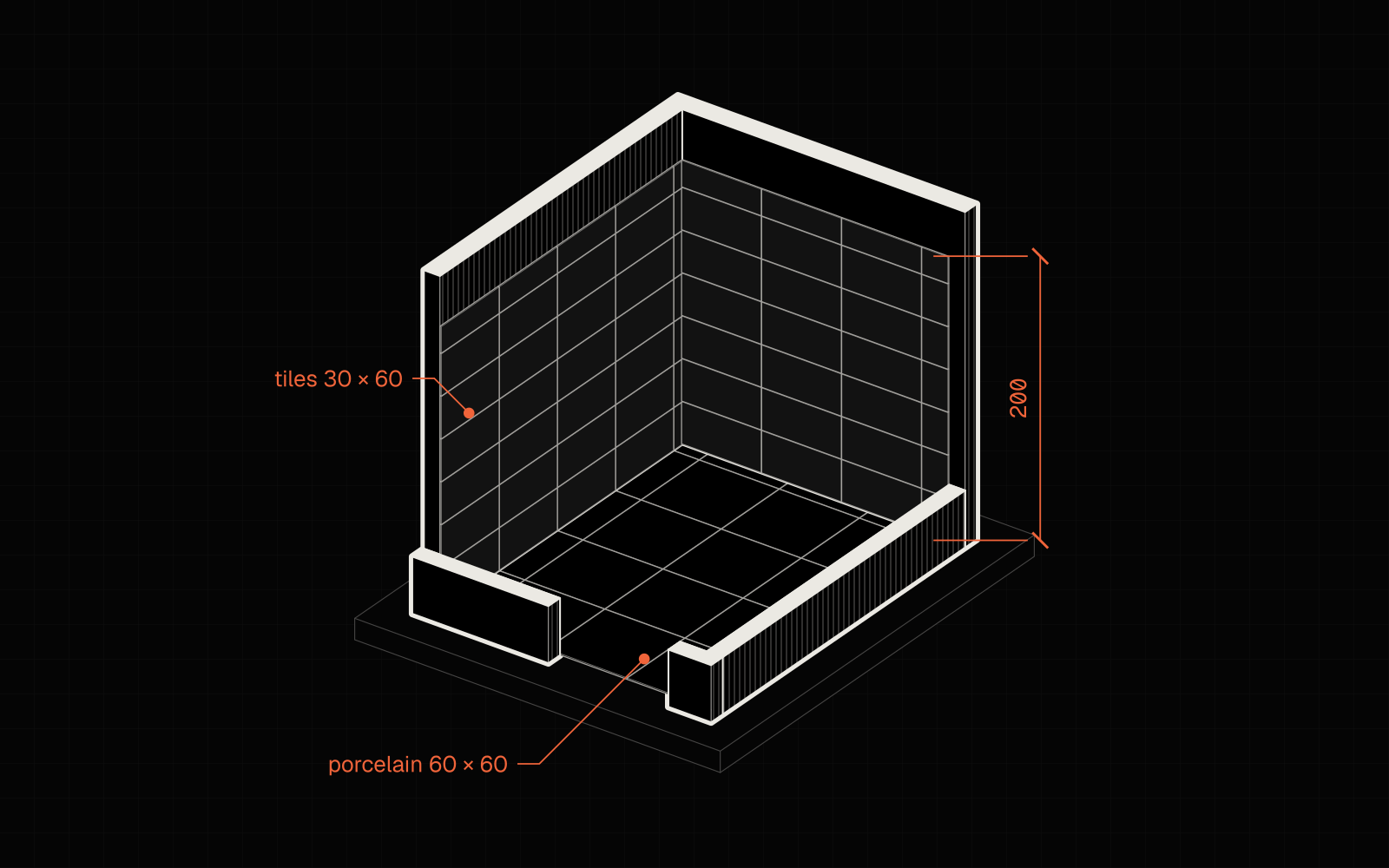
For a 2 × 2.5 m bathroom, buy 4 boxes of 60 × 60 cm porcelain tiles for the floor and 13 boxes of 30 × 60 cm tiles for walls tiled to a height of 2 m, counting 10% waste each for a straight pattern, as the Polish tile maker Opoczno recommends. For a diagonal pattern you need about 15%.
How to calculate
boxes = area × (1 + waste) ÷ m² per box, rounded up
Floor. Measure the room between the walls and work out the area. Split an alcove or an L-shaped room into rectangles. You do not have to tile the floor under the bath or shower tray, but many people do it to be tidy: decide before you buy.
- full 60 × 60 cm tile
- cut tile
Walls. Work out the room's perimeter and multiply it by the height you are tiling to (in a bathroom often 2.0 m or up to the ceiling). Deduct the doors and windows. Count the wall behind the bath and any wall hidden by boxing-in according to whether it will really be tiled.
- full 30 × 60 cm tile
- cut tile
Boxes. The number of m² per box is on the packaging: for 60 × 60 cm tiles it is usually 1.44 m² (4 tiles), and for 30 × 60 cm from 1.08 to 1.44 m². Buy all the boxes from one production batch, with the same calibre and shade, because the next delivery may differ.
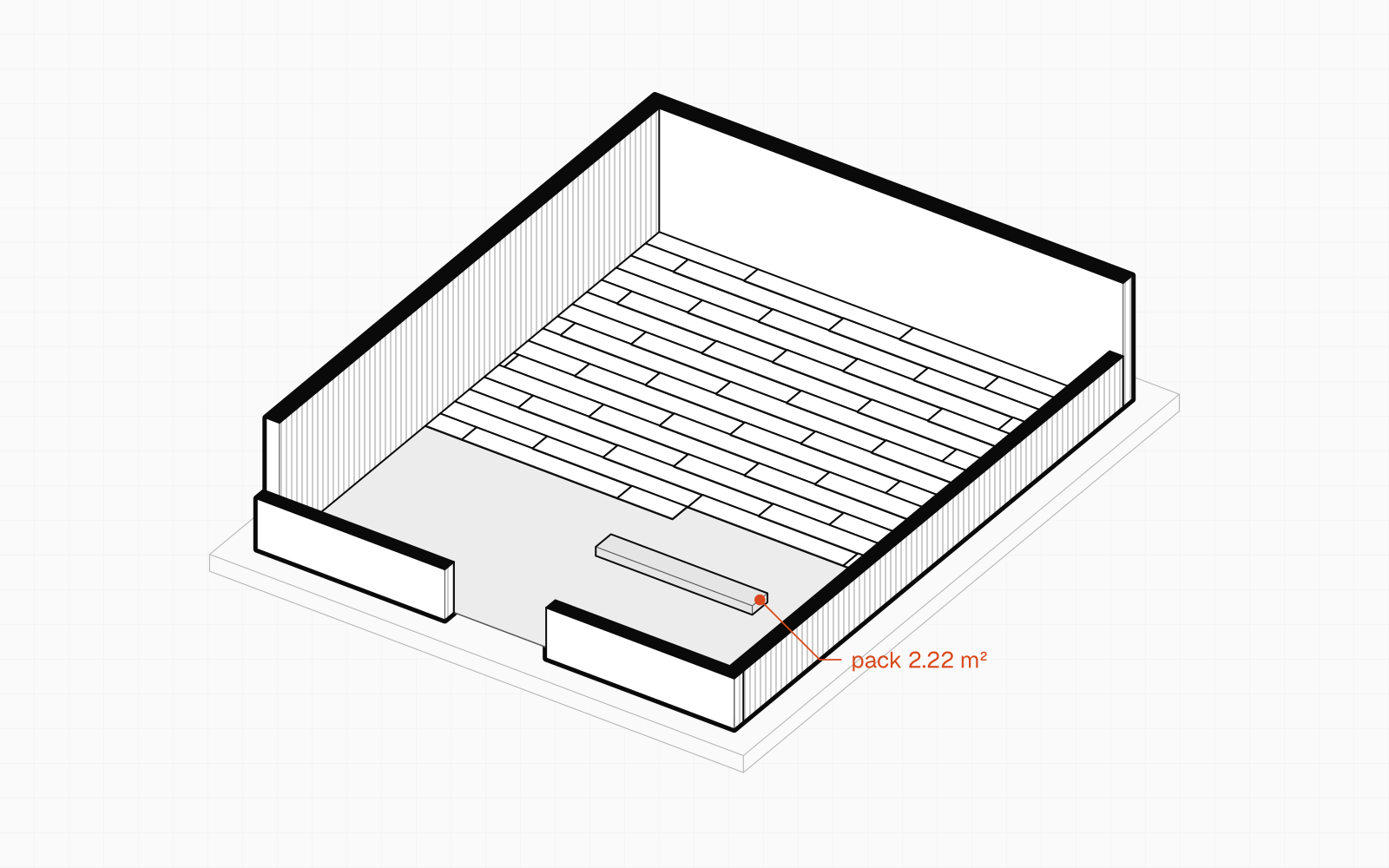
Adhesive. How much adhesive you use depends on the size of the trowel notch, and that depends on the tile size: the larger the tile, the thicker the adhesive bed. Baukit counts 2.5 kg/m² for tiles up to 20 cm, 3 kg/m² up to 30 cm, 3.5 kg/m² for 30 × 60 cm, 4 kg/m² for 60 × 60 cm porcelain and 4.5 kg/m² for larger sizes. Details are in the article how much tile adhesive per m².
Grout. You work out the grout from the grout makers' formula:
grout [kg/m²] = (A + B) ÷ (A × B) × joint width × joint depth × 1.6
where A and B are the tile's dimensions in millimetres, the joint width and depth are also in millimetres, and 1.6 is the density of the grout in kg/dm³. Examples and a table are in the article how much grout per m².
Waterproofing. In the shower area and around the bath, a waterproofing layer goes under the tiles (a liquid membrane, with sealing tape in the corners). The manufacturer gives how much it takes, usually in kg/m² for two coats.
Waste
| Pattern and room | Waste in Baukit | Why |
|---|---|---|
| Straight, in any room | 10% | Cuts along the walls |
| Offset (“brick bond”) | 12% | Staggered rows leave more cuts along the walls |
| Diagonal (45°) | 15% | Triangular cuts along every wall |
| Herringbone | 15% | Short pieces and cuts along every wall |
- Straight, in any room10%
- Offset (“brick bond”)12%
- Diagonal (45°)15%
- Herringbone15%
The 10% waste for a straight pattern is what the tile maker Opoczno recommends, in a large room too; the waste for the other patterns is tilers' practice. Baukit counts with the same values, by pattern and not by tile size. Large tiles (for example 60 × 120 cm) in a small room may need more, because every cut takes a big piece of a tile: check the cutting layout and buy an extra box if needed, because Baukit does not add it. With tiles from a collection that may be discontinued, add a few tiles for future repairs.
Example: a 2 × 2.5 m bathroom
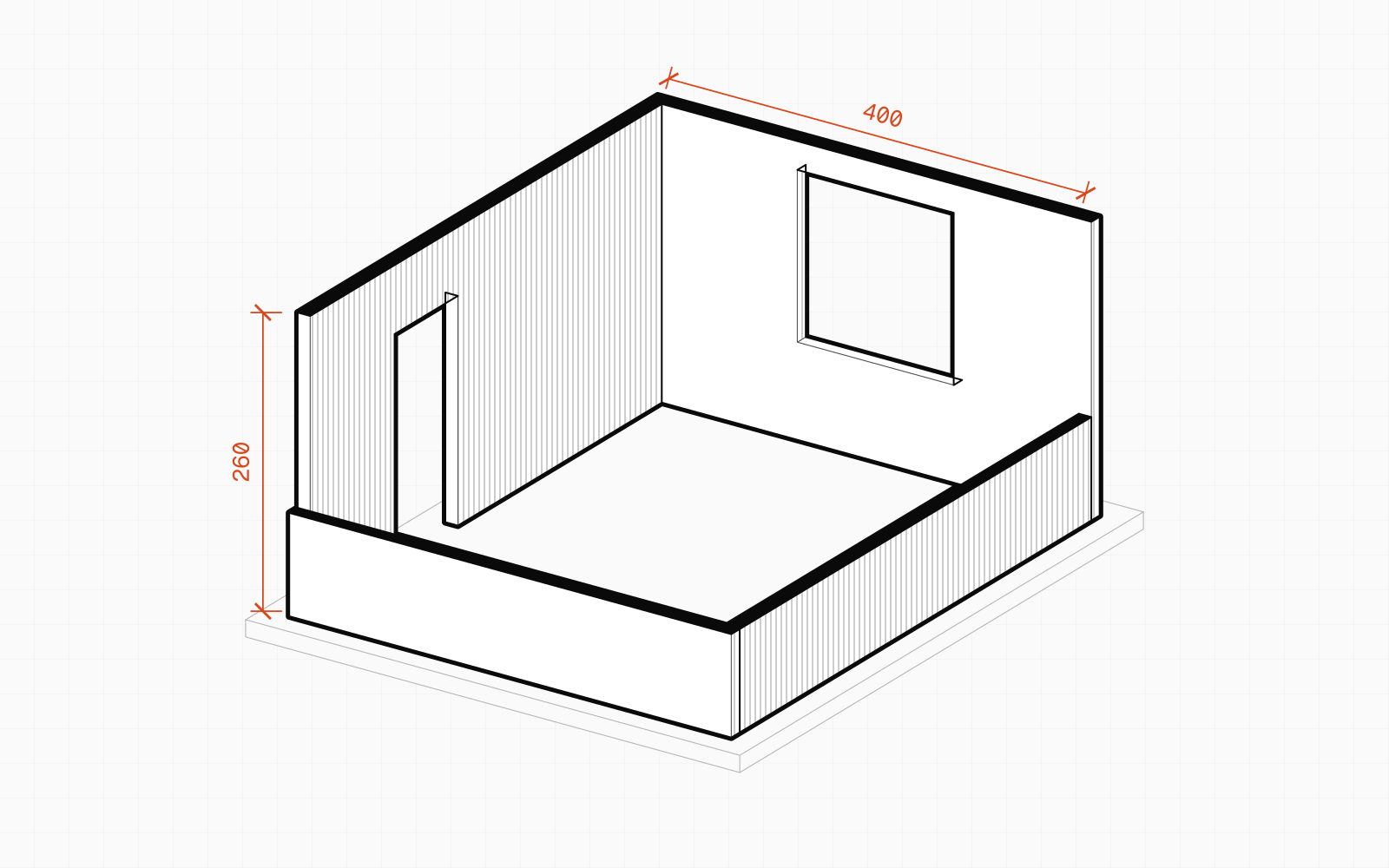
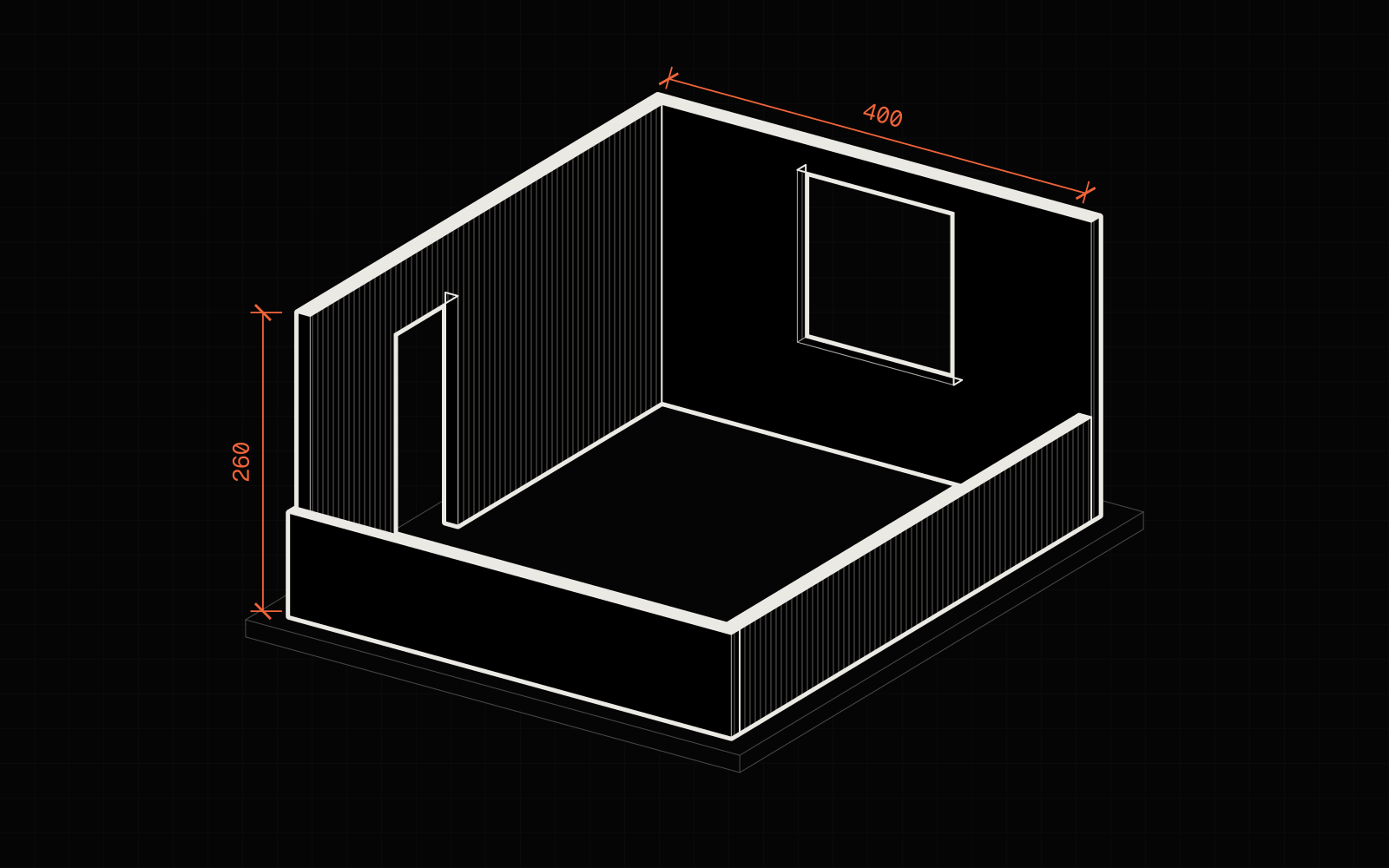
Assumptions: a 2.00 × 2.50 m bathroom, a 0.90 × 2.00 m door, wall tiles to a height of 2.00 m all round. Floor: 60 × 60 cm porcelain tiles, box of 1.44 m². Walls: 30 × 60 cm tiles, box of 1.44 m². Waste 10% (straight pattern). Joint 2 mm. The example in Baukit uses the same data.
Walls 16.20 m² × 1.10 = 17.82 m² ÷ 1.44 = 12.38 → 13
- Walls without the door
- 16.20 m²
- Adhesive with 5% waste
- 80.5 kg
- Adhesive bags 25 kg
- 4 pcs
- Grout
- 2.6 kg
- Grout with 10% waste
- 2.9 kg
- Packs 5 kg
- 1 pcs
- Floor. 2.00 × 2.50 = 5.00 m². With 10% waste: 5.50 m². 5.50 ÷ 1.44 = 3.82, so 4 boxes (5.76 m²).
- Walls. Perimeter 2 × (2.00 + 2.50) = 9.00 m. 9.00 × 2.00 = 18.00 m², minus the door 0.90 × 2.00 = 1.80 m², gives 16.20 m².
- Wall tiles. 16.20 × 1.10 = 17.82 m². 17.82 ÷ 1.44 = 12.4, so 13 boxes (18.72 m²).
- Adhesive. Floor 5.00 × 4.0 kg/m² = 20.0 kg, walls 16.20 × 3.5 kg/m² = 56.7 kg. In total 76.7 kg, with 5% waste about 81 kg, so 4 bags of 25 kg.
- Grout for the floor. (600 + 600) ÷ (600 × 600) × 2 × 10 × 1.6 = 0.107 kg/m², so 5.00 × 0.107 = 0.53 kg.
- Grout for the walls. (300 + 600) ÷ (300 × 600) × 2 × 8 × 1.6 = 0.128 kg/m², so 16.20 × 0.128 = 2.07 kg.
- Grout in total. 2.6 kg, with 10% waste about 2.9 kg: one 5 kg pack (or two 2 kg packs if the floor and the walls are to have different grout colours).
- Porcelain 60 × 60 cm4boxes of 1.44 m² (5.76 m²)
- Wall tiles 30 × 60 cm13boxes of 1.44 m² (18.72 m²)
- C2TE adhesive4bags of 25 kg (approx. 81 kg)
- Cement grout1pack of 5 kg (approx. 2.9 kg)
- Primer and waterproofingper designwaterproofing in the shower area, tape, corner trims, silicone: according to the bathroom design
In this bathroom the tiles cover about 21 m², while the floor is only 5 m². In small bathrooms there is usually three to four times more wall to tile than floor, so it is the walls that decide the cost of the tiles.
What it costs
| Material | Typical price | ||
|---|---|---|---|
| Porcelain tile 60×60 cm (glazed / polished)Pack: box 1.44 m² (4 pcs) | 64.13 PLN/m²approx. 92 PLN per packexample: 4 packs, approx. 369 PLN58.84–66.90 · 2 shops | 58.84–66.90 | 2 shops |
| Ceramic wall tile 30×60 cmPack: box (usually 1.08–1.44 m²) | 29.84 PLN/m²approx. 43 PLN per packexample: 13 packs, approx. 559 PLN29.77–29.91 · 2 shops | 29.77–29.91 | 2 shops |
| Flexible tile adhesive C2TE, 25 kg bagPack: 25 kg bag | 2.39 PLN/kgapprox. 60 PLN per packexample: 4 packs, approx. 239 PLN1.72–3.16 · 4 shops | 1.72–3.16 | 4 shops |
| Flexible cement grout, 5 kgPack: 5 kg pack (also 2 kg) | 13.23 PLN/kgapprox. 66 PLN per packexample: 1 pack, approx. 66 PLN11.80–13.98 · 3 shops | 11.80–13.98 | 3 shops |
| Under-tile waterproofing (liquid membrane), 5 kgPack: 5 kg bucket (also 12–15 kg) | 19.18 PLN/kgapprox. 96 PLN per pack16.64–23.60 · 3 shops | 16.64–23.60 | 3 shops |
| Deep-penetrating primer, 5 lPack: 5 l can (also 10 l) | 10.52 PLN/lapprox. 53 PLN per pack10.30–11.98 · 3 shops | 10.30–11.98 | 3 shops |
| PVC tile trim 8–10 mm, 2.5 mPack: 2.5 m piece | 7.60 PLN/mapprox. 19 PLN per pack7.00–8.20 · 2 shops | 7.00–8.20 | 2 shops |
| Aluminium tile trim 8–10 mm, 2.5–2.7 mPack: 2.5 m piece (also 2.7 m) | 23.96 PLN/mapprox. 60 PLN per pack11.96–25.92 · 3 shops | 11.96–25.92 | 3 shops |
| Sanitary silicone (white / clear), 280–310 ml cartridgePack: 280–310 ml cartridge | 31.90 PLN/pc29.90–39.70 · 3 shops | 29.90–39.70 | 3 shops |
| Worked example, total | approx. 1,233 PLN | ||
The “Worked example, total” row is the cost of the materials in the example above: 4 boxes of porcelain floor tiles, 13 boxes of wall tiles, 4 bags of adhesive and 1 pack of grout, without the waterproofing, primer, trims and silicone.
The prices in the table are the median of offers from several Polish shops, including VAT, with the date. Tile prices depend above all on the collection, so treat them as a reference point, and the cost of the adhesive and grout as the more certain part of the estimate.
Calculate it in Baukit
Open in Baukit- Click “Open in Baukit”. A 2 × 2.5 m bathroom opens with a door and the notebook open.
- The bathroom is already selected. The notebook shows the floor and wall tiles in m² with waste, the adhesive and grout in kg, and also the paint and primer for the ceiling and for the walls above the tiles.
- Switch to “Floors” mode and select the bathroom floor. The panel on the right shows its product and the “Size” 60 × 60 cm. The size belongs to the product: 60 × 120 cm tiles are a different finish, so you do not change it on the floor alone.
- Change the “Pattern” to “Diagonal, 15% waste”: the floor tiles go up from 5.50 to 5.75 m². The pattern, rotation and start corner belong to this one floor, and the 3D view shows the tiles in that pattern.
- Go back to “Structure” mode and select the bathroom. The wall finish belongs to the room: in the panel on the right, under “Finishes”, next to “Walls”, click the “Wall tiles” band (0–200 cm) and change “To” to, say, 120 cm. You can also drag the edge of the band on the unfolded walls of the bathroom above the list.
- The wall tiles and adhesive go down, and the paint goes up.
- Press Esc so that nothing is selected: the whole-building view shows how many boxes of tiles and bags of adhesive that is.
- You open the notebook with the “Notebook” button in the bottom left corner or with the 4 key.
You change the pattern for each floor separately, and you choose the size together with the product. Baukit counts the wall tiles as they are laid: the waste for the pattern chosen for the room's walls (10% for a straight pattern), and the adhesive and grout by the tile size. A band of tiles, like the one in this example, is counted as a straight pattern. It does not count the waterproofing yet: add it from the product data sheet.
The same drawing also works out the paint for the walls above the tiles and the floors in the other rooms.
Frequently asked questions
How many tiles for a 5 m² bathroom?
For the 5 m² floor alone with 10% waste you need 5.5 m², which is 4 boxes of 1.44 m². The walls of a bathroom like this, tiled to 2 m, usually take 15–20 m² of tiles. Work them out separately, from the perimeter and the height, without the door.
How much waste should I allow for tiles?
For a straight pattern 10%: that is what the tile maker Opoczno recommends and what Baukit counts, in a small bathroom and in a large room alike. For an offset pattern allow 12%, for a diagonal one 15%, and for herringbone 15%. Also check how much waste the rounding up to whole boxes already gives you.
How much tile adhesive per 1 m²?
It depends on the tile size and the trowel notch. Baukit counts from 2.5 kg/m² for small wall tiles and 4 kg/m² for 60 × 60 cm porcelain up to 4.5 kg/m² for larger sizes. If you spread adhesive on both the substrate and the tile, you use more, and Baukit does not add that. The adhesive maker gives the exact consumption for each trowel on the bag.
Do tiles have to be bought from one batch?
Yes. Tiles from different batches can differ in shade and calibre (exact size), which shows once they are laid. So buy the whole quantity with the waste at once and check the batch markings on the boxes.
Should I deduct doors and windows from the wall area?
Doors, yes, because they take up a large part of the wall. You can deduct a small window, but remember the reveals: if you tile them, add their area. With many cuts around a window, the waste will cover the difference anyway.
Related
- How much tile adhesive per m²? A table by tile size
- How much grout per m²? Formula and an example for 60 × 60 tiles
5 sources
- Waste for cuts: 10% for a straight pattern according to Opoczno's tile-laying guidelines; waste for offset, diagonal and herringbone patterns: tilers' practice (not checked). Shops' guides give less for a straight pattern in a large room; Baukit follows the manufacturer's recommendation.
- Adhesive consumption by tile size and trowel notch: technical data sheets of the C2TE adhesives Atlas Plus (https://media.adeo.com/media/5991614/media.pdf) and Ceresit CM 17 (https://datasheets.tdx.henkel.com/CERESIT-CM-17-en_GL.pdf), read on 13 October 2026.
- Grout consumption formula and density of 1.6 kg/dm³: technical data sheets of cementitious grout manufacturers (not checked).
- Waterproofing in wet areas: guidelines of manufacturers of under-tile waterproofing systems (not checked).
- Box sizes: the Baukit materials catalogue, October 2026.