- Shell
- Blocks and mortar
- Wojciech Dobry
- October 2026
- about 8 min
- 3:01, Polish captions
How many blocks for a 100 m² house? Porotherm, Ytong, Solbet and Silka
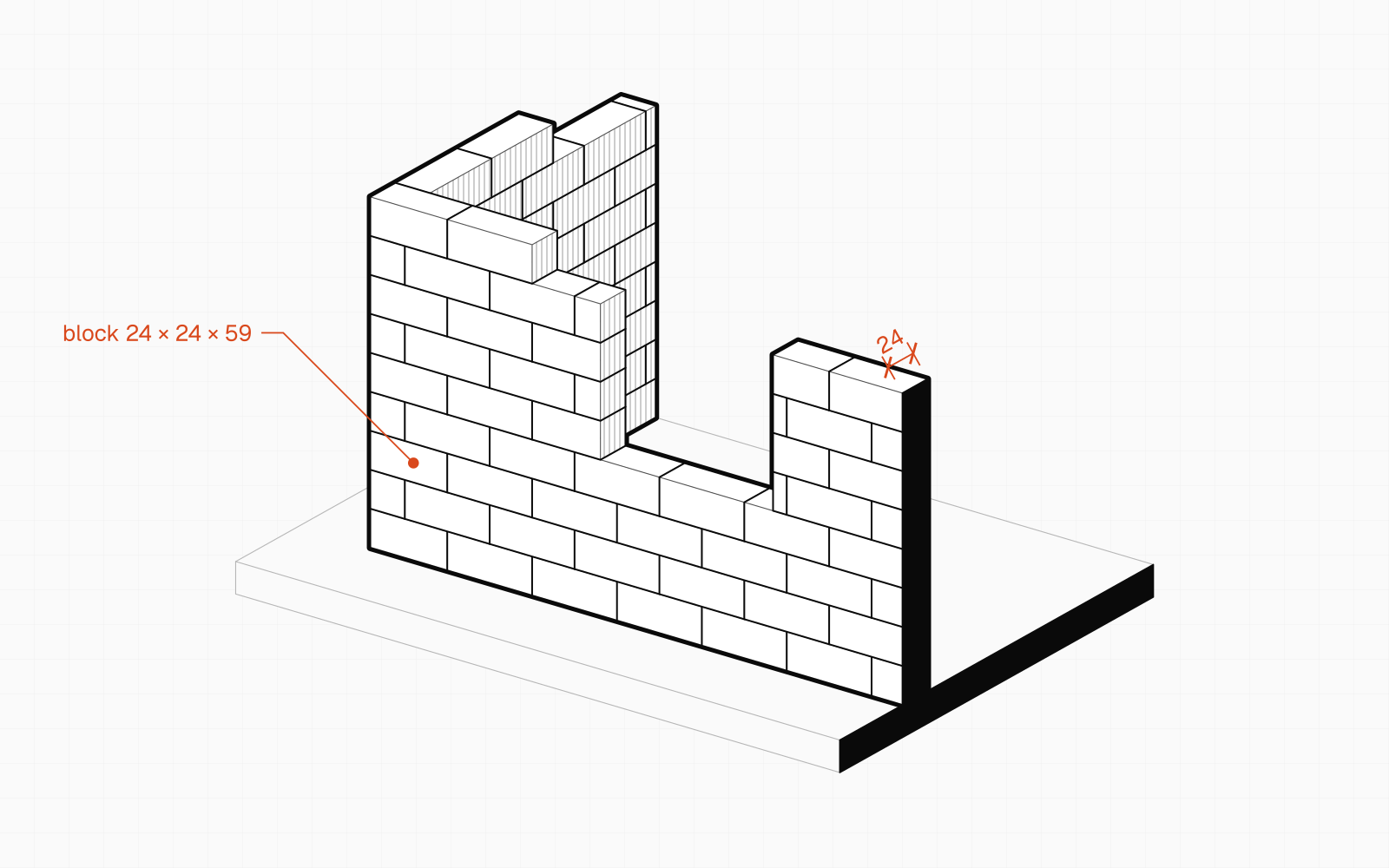
For the external walls of a 10 × 10 m single-storey house (about 91 m² of masonry without windows and doors), buy about 665 aerated concrete blocks of 24 × 24 × 59 cm or about 1,010 Porotherm 25 P+W clay blocks, counting 3% waste. The number of blocks per square metre depends only on the size of the block's face: from about 7 with large blocks to 15.02 with calcium silicate blocks.
How to calculate it
blocks = net wall area × blocks per m² × (1 + waste)
blocks per m² = 1 ÷ (block length × block height), with the sizes in metres including the joint
Wall area. For each wall: length on the axis × masonry height, minus windows and doors. The masonry height is the height of the block wall, without the ring beam and without the footing. In a house with an attic storey, add the knee walls and the gables (triangles: half the base × the height). Count the external walls, the internal load-bearing walls and the partitions separately, because they usually differ in thickness and material.
Openings. Deduct the windows and doors by the size of the opening in the masonry. Lintels sit above the openings and take the place of blocks, so if you count precisely, deduct their face too.
Blocks per m². You work it out from the block's length and height as seen on the wall, including the joint. For blocks laid on a thin joint (about 2 mm) you count the modular size, e.g. 59 × 24 cm or 60 × 20 cm. Tongue-and-groove blocks (P+W in Polish) have no vertical joint, and the horizontal one is about 1 cm. The wall's thickness (24 or 25 cm) does not change the number of blocks per m², only their price and weight. Baukit counts clay and calcium silicate blocks at the number per m² the manufacturers give, and aerated concrete blocks from the face.
| Block (wall thickness) | Face with joint | Blocks per m² |
|---|---|---|
| Aerated concrete 24 cm, 24 × 24 × 59 cm format, e.g. Solbet (59 × 24 cm) | 59 × 24 cm | 7.06 |
| Aerated concrete 24 cm, 24 × 20 × 60 cm format, e.g. Ytong (59.9 × 19.9 cm) | 60 × 20 cm | 8.33 |
| Clay block 25 P+W, e.g. Porotherm (37.3 × 23.8 cm) | 37.3 × 25 cm | 10.7 |
| Calcium silicate block 24 cm, e.g. Silka | per manufacturer | 15.02 |
The block sizes are typical formats from the manufacturers' data sheets. Always check the format of the actual product, because the same manufacturer sells blocks of different heights. You can work out the number per m² for other formats in the article how many blocks per m² of wall.
Mortar. Aerated concrete and calcium silicate blocks are laid on thin-bed mortar (block adhesive); P+W clay blocks usually on ordinary mortar, or on foam or thin-joint mortar, depending on the system. The block manufacturer gives the consumption. More in the article how much adhesive for blocks per m².
Waste
| Situation | Waste in Baukit | What else |
|---|---|---|
| Straight walls, blocks with halves and make-up pieces | 3% | Cuts at corners and openings fit within the waste |
| Many windows, corners and recesses | 3% | More cuts, and some blocks crack when cut: add a few blocks |
| Calcium silicate and clay blocks without make-up pieces | 3% | Cutting heavy blocks gives more offcuts: add a few blocks |
Baukit adds 3% to every wall, whatever the type of block and the number of openings. This waste is site practice. You usually buy blocks by the full pallet, and many builders' merchants take back unused pallets. Ask about it before you buy.
Example: a 10 × 10 m single-storey house
Assumptions: a single-storey house, external walls on a 10 × 10 m plan measured on the axes, masonry height 2.70 m (up to the ring beam). Six windows of 1.20 × 1.50 m, a front door of 1.00 × 2.10 m and a terrace door of 1.80 × 2.10 m. Aerated concrete blocks of 24 × 24 × 59 cm (59 × 24 cm on the wall, 7.06 blocks per m²), 3% waste. The example in Baukit uses the same data.
- block masonry
- 6 windows 1.20 × 1.50 m, door 1.00 × 2.10 m, terrace door 1.80 × 2.10 m
- Gross wall. Perimeter on the axes 4 × 10.00 = 40.00 m. 40.00 × 2.70 = 108.00 m².
- Openings. Windows 6 × 1.20 × 1.50 = 10.80 m², front door 2.10 m², terrace door 3.78 m². Total 16.68 m².
- Net wall. 108.00 − 16.68 = 91.32 m².
- Blocks. 91.32 × 7.06 = 645 blocks. With 3% waste: 665 blocks.
- Thin-bed mortar. At about 4 kg/m² of 24 cm wall: 91.32 × 4 = 365 kg, which is 15 bags of 25 kg.
- Aerated concrete blocks 24 cm66591.32 m² × 7.06 pcs/m² + 3%
- Thin-bed mortar1525 kg bags (365 kg)
- Net wall91.32 m²108.00 m² − 16.68 m² of openings
The same wall in other materials (with 3% waste):
| Material | Blocks per m² | Blocks for 91.32 m² |
|---|---|---|
| Aerated concrete 24 cm (59 × 24 cm) | 7.06 | 665 |
| Aerated concrete 24 cm (60 × 20 cm) | 8.33 | 784 |
| Clay block 25 P+W | 10.7 | 1,007 |
| Calcium silicate block 24 cm | 15.02 | 1,413 |
More blocks does not mean more expensive: compare the cost of a square metre of wall, not the price of one block.
- Gross wall
- 108.00 m²
- Net wall
- 91.32 m²
- Without waste
- 645 pcs
- Thin-bed mortar
- 365 kg · 15 bags
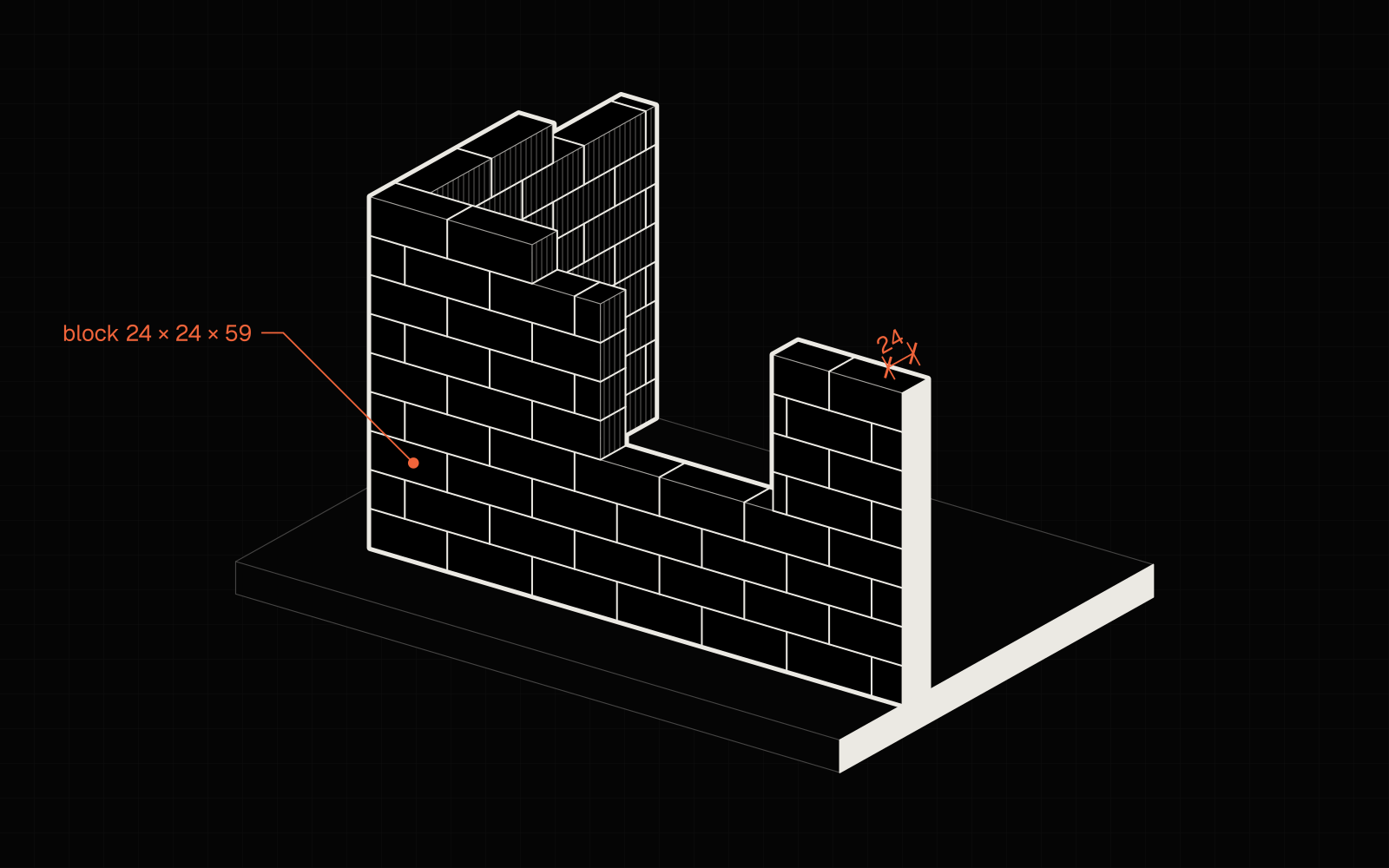
This is 1 m² of wall from the chosen block. Blue is one block: the smaller the face, the more blocks per metre.
A real house for comparison. In the free “PS.Arch 150” design from the catalogue of GUNB, the Polish building control authority (a house with an attic storey, about 153 m² of usable floor area), the 24 cm aerated concrete external walls have 135.18 m² of net masonry (78.48 m² on the ground floor and 56.70 m² in the attic), and the 12 cm partitions another 132.43 m². At 7.06 blocks per m² (a 59 × 24 cm face) and 3% waste, that is about 985 blocks of 24 cm and about 965 blocks of 12 cm. From a drawn model of this house, Baukit works out 134.54 m² of external walls.
What it costs
| Material | Typical price | ||
|---|---|---|---|
| Aerated concrete block 24×24×59 (grade 500–600)Pack: piece (pallet approx. 40–48 pcs) | 16.20 PLN/pcexample: 665 packs, approx. 10,773 PLN15.59–17.33 · 3 shops | 15.59–17.33 | 3 shops |
| Ceramic hollow block 25 tongue-and-groove (e.g. Porotherm 25)Pack: piece (pallet approx. 60–80 pcs) | 10.21 PLN/pc7.58–12.46 · 8 shops | 7.58–12.46 | 8 shops |
| Sand-lime block 24 cm (e.g. Silka E24)Pack: piece (pallet) | 9.47 PLN/pc8.95–12.98 · 6 shops | 8.95–12.98 | 6 shops |
| Aerated concrete block 12×24×59 (partitions)Pack: piece (pallet approx. 80–96 pcs) | 8.97 PLN/pc8.49–9.69 · 3 shops | 8.49–9.69 | 3 shops |
| Concrete foundation block 38×24×12Pack: piece (pallet approx. 60–80 pcs) | 5.40 PLN/pc4.69–5.50 · 3 shops | 4.69–5.50 | 3 shops |
| Thin-bed mortar (adhesive) for aerated concrete, 25 kg bagPack: 25 kg bag | 0.89 PLN/kgapprox. 22 PLN per packexample: 15 packs, approx. 333 PLN0.76–1.00 · 4 shops | 0.76–1.00 | 4 shops |
| Lime-cement masonry mortar, 25 kg bagPack: 25 kg bag | 0.64 PLN/kgapprox. 16 PLN per pack0.62–0.67 · 3 shops | 0.62–0.67 | 3 shops |
| Precast lintel beam L19, 1.2 mPack: piece | 46.53 PLN/pc32.73–51.90 · 3 shops | 32.73–51.90 | 3 shops |
| Worked example, total | approx. 11,106 PLN | ||
The “Worked example, total” row is the cost of the materials from the example above: 665 aerated concrete blocks of 24 cm and 15 bags of thin-bed mortar, without lintels and without delivery to site.
The prices in the table are the median of offers from several shops, including VAT, dated, per piece or per kilogram. Blocks are usually sold by the pallet, with delivery charged separately. So when you compare offers, ask for the price delivered to site.
Work it out in Baukit
Open in Baukit- Click “Open in Baukit”. A 10 × 10 m single-storey house opens with windows and the notebook open.
- The external walls are already selected. The notebook shows the blocks in pieces and the mortar in kg, plus the concrete and steel for the ring beams and lintels.
- In the panel on the right, click the layers icon next to the wall type, and in the “Wall types” window click “Add Polish presets”. Close the window, click the wall type and choose “Ceramic block 25 + graphite EPS 15”: instead of aerated concrete blocks you will see clay blocks and masonry mortar. Compare the result.
- Press Esc so that nothing is selected: the whole-building view shows how many blocks and bags to buy. When you draw in the partitions, they are counted here together with the external walls.
- Open the notebook with the “Notebook” button in the bottom left corner or with the 4 key.
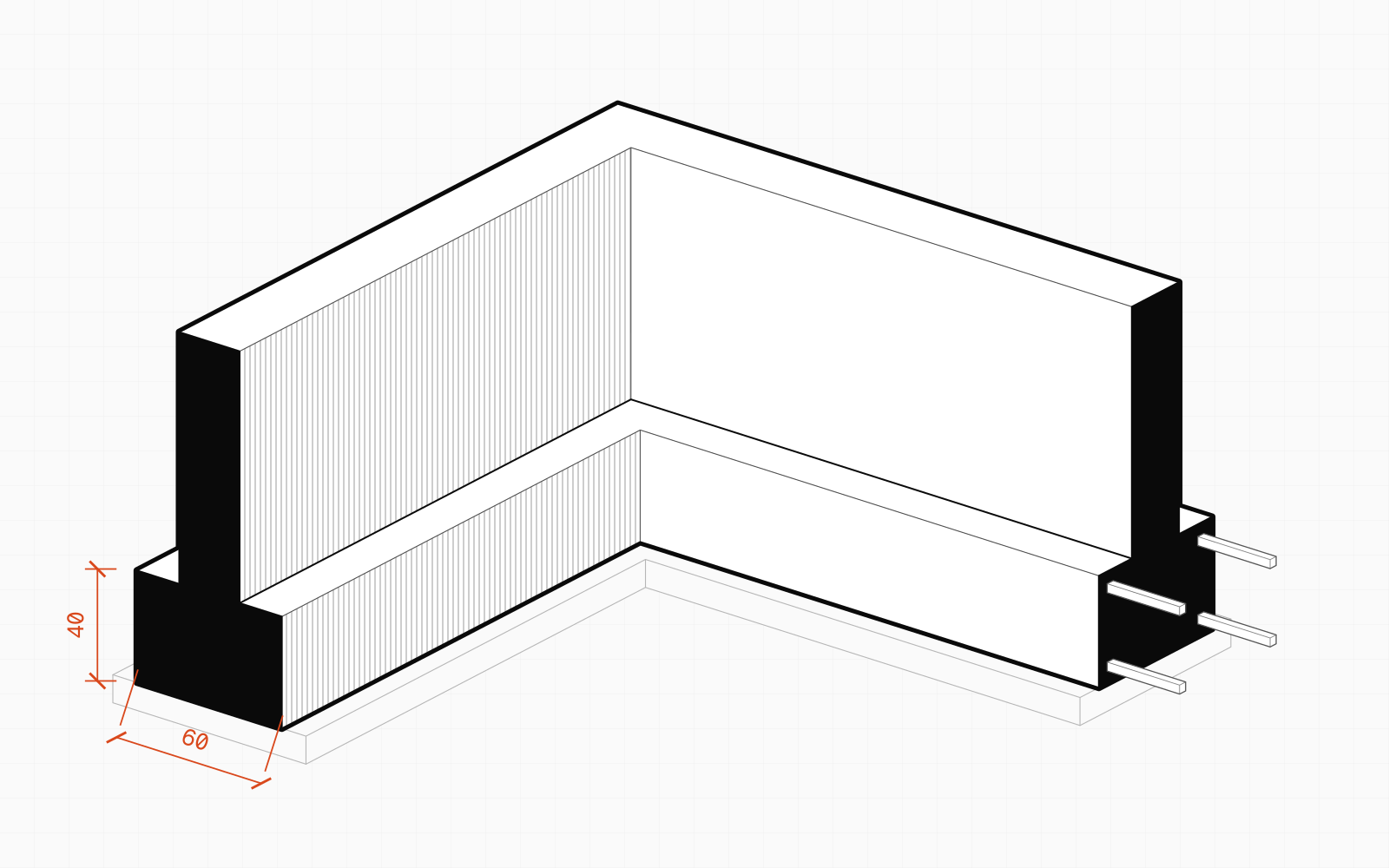
The same model also works out the concrete for the footings and ring beams, and the wall insulation.
Frequently asked questions
How many blocks per 1 m² of wall?
Divide 1 by the length and height of the block's face in metres, including the joint. For a 59 × 24 cm aerated concrete block that gives 7.06 blocks per m², and for the 60 × 20 cm format 8.33. Clay and calcium silicate blocks are counted as the manufacturer states: Baukit takes 10.7 blocks per m² for a 25 P+W clay block and 15.02 for a 24 cm calcium silicate block.
How many blocks for a 100 m² house?
It depends on the length and height of the walls, not on the floor area of the house. A 10 × 10 m single-storey house has about 90 m² of external wall without the windows, which is about 665 aerated concrete blocks of 24 × 24 × 59 cm or about 1,000 clay blocks. A house with an attic storey or an upper floor has proportionally more, and the partitions add as many again.
Should I deduct windows from the wall area?
Yes, deduct windows and doors in full, by the size of the opening in the masonry. In a detached house the openings are usually 15–35% of the external wall: in “Wariant I” as much as 34% on the ground floor, because the house has large glazed areas.
How much adhesive for aerated concrete blocks?
Thin-bed mortar consumption is usually a few kilograms per square metre of 24 cm wall, and less with tongue-and-groove blocks. The block manufacturer gives the exact consumption. Details in the article how much adhesive for blocks per m².
How many blocks to a pallet?
That depends on the manufacturer and the format: a pallet of 24 cm aerated concrete blocks usually holds a few dozen, and a pallet of 25 cm clay blocks about 60–80. Check the number per pallet with the manufacturer, because it decides the number of pallets and the deposit on them.
Related
- How many blocks per m² of wall? A table for popular blocks
- How much Ytong adhesive per m²? Ordinary versus thin-bed mortar
5 sources
- Block formats and the number per m²: manufacturers' data sheets (Ytong, Solbet, Porotherm, Silka) (formats to be confirmed; not checked).
- Thin-bed mortar consumption: Solbet gives 4.3–4.5 kg/m² of 24 cm wall from smooth blocks, H+H 2.4 kg/m² for tongue-and-groove blocks; 4 kg/m² is a value between them, read on 13 October 2026.
- Waste for cuts and the number per pallet: site practice, builders' merchants' offers (not checked).
- “PS.Arch 150”, przedmiar robót budowlanych (bill of quantities), author: PS.Arch Piotr Świątkiewicz, 20 November 2023; Główny Urząd Nadzoru Budowlanego, katalog bezpłatnych projektów domów (in Polish), published 15 December 2023 (in the downloads as “Wariant I”): 24 cm aerated concrete walls and 12 cm partitions.
- Wall area of “PS.Arch 150” from the model: Baukit calculation, 11 October 2026.